
Two incidents that generated worldwide headlines in recent months have called attention to the often-overlooked plight of India’s captive elephants.
In the first, an elderly female elephant died three months after she was painted pink by a Russian photographer.
Then, this May, a young tusker attacked an older, tuskless male elephant at a camp run by the forest department, leading to the death of a tourist and the elder elephant.
Although media around the world carried news about these two sad events, they’re not exactly isolated occurrences. Over the past year alone, multiple distressed elephants used in temple festivities have gone on rampages and killed people, or have suffered immensely and died.
The deaths underscore a hidden reality: Despite India’s designation of the elephant as the national heritage animal, the country allows the animals to be privately owned, which has created opportunities for them to be trafficked and exploited.
“India has an ancient cultural relationship with elephants,” says Kartick Satyanarayan, CEO and co-founder of Wildlife SOS, an animal-welfare and conservation organization headquartered in New Delhi. “But in today’s day and age, captive elephants live in a highly compromised situation as their physical, social and psychological needs are not met. Many elephants succumb to serious health and welfare issues over time.”
View this post on Instagram
An estimated 3,000 elephants live in captivity across the country. Of these, about 70% are privately owned – either by individuals or institutions – with a majority spending their lives in horrific conditions. Owners use these elephants for providing rides to tourists, parades at religious festivals, begging, and other exploitative activities, despite the serious concerns raised by animal-welfare activists.
The rest are owned by the various forest departments in the country, where they’re mainly used for anti-poaching patrols or forest-management activities and are better cared for than privately owned elephants.
A subspecies of the Asian elephant, Indian elephants (Elephas maximus indicus) are classified as “endangered” by the International Union for Conservation of Nature (IUCN). They’re native to 11 countries in south and southeast Asia, and India is home to nearly 75% of the subspecies’ population. The latest census in India (2021-2025) estimated the wild elephant population to be 22,446.
Elephants receive the highest level of protection under Indian law. Yet traffickers take advantage of longstanding legal loopholes and continue to poach calves from the wild, torture them into submission, and exploit them in captivity.
“The law, though strong in intent, has enough structural gaps to render its protections largely ineffective in practice,” says advocate Rishabh Karan Mehta, who practices at India’s Supreme Court.
“Every elephant removed from the wild is a loss to the gene pool and genetic diversity of the wild population,” says Satyanarayan.
According to Mehta, a 2020 response to a Right to Information petition revealed that roughly 1 in 4 privately owned captive elephants lacked proper supporting documentation.
“That’s how widespread the problem is,” he says.
Captive Elephants in Tourism
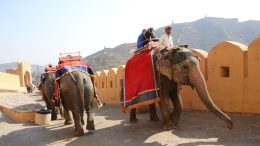
Elephant riding continues to be touted by some travel agents as a must-do experience in India. Over 100 elephants ferry eager tourists to Amer Fort in the northwestern state of Rajasthan, for example.
“Tourists who ride elephants are often misled,” says Satyanarayan. “Their cultural experience is built entirely on the suffering and abuse of the elephant and causes irreversible damage to its spine and back.”
Several of the elephants at Amer Fort are blind, crippled, and have scores of wounds and abscesses. “These injuries are masterfully concealed beneath colorful decorations, velvet fabrics and paint,” says Satyanarayan.
Snatched from their mothers at an early age, elephant calves undergo a brutal “breaking-of-the-spirit” process involving severe beatings and starvation. Once they’ve submitted to their captors, they spend decades of their lives in chains, abused and neglected until death saves them from their daily suffering.
Two Cases That Ignited Firestorms
In November 2025 a Russian photographer visiting Amer Fort asked for a captive elephant to be painted bright pink for a photoshoot. The owner of an elderly elephant named Chanchal agreed. When the images of the “pink elephant” were shared on social media, a global furor erupted about the ethics of using animals in such projects.
“It’s deeply troubling that people don’t hesitate to use elephants as props and abuse them in the process,” says Satyanarayan. “It shows how little consideration there is for the elephant’s welfare,” he adds.
Three months later, Chanchal — who was in her mid-60s — died. Though the post-mortem said that she died of age-related issues, a lifetime of captivity and neglect would have had an impact on her health and wellbeing, Satyanarayan says.
“Chanchal spent decades without ever knowing a day of true freedom, a victim exploited by people for greed and profit,” he says.
Another gruesome incident in the southern state of Karnataka reignited the conversation around elephant captivity. In May, during an elephant bathing activity in the Cauvery River at the forest department-run Dubare camp, a 26-year-old tusker named Kanjan attacked an older tuskless male, Marthanda.
“These situations can occur when captive bull elephants are in proximity to each other,” says Satyanarayan.
The older elephant lost his footing in the water and fell on a female tourist standing nearby, killing her instantly. Marthanda later succumbed to his injuries as well.
“When camps become tourism attractions, then the welfare and safety of visitors and elephants needs to be the highest priority,” says Satyanarayan. “Placing visitors in close proximity to elephants can create dangerous situations for both.”
Though the camp authorities responded swiftly by stopping all close contact activities, including elephant bathing, feeding, and selfies, the measures came too late for the tourist and the elephant who lost their lives in this entirely preventable tragedy.
Captive Elephants at Religious Festivals
The southern state of Kerala has a tradition of parading richly dressed captive elephants as part of festival processions. Some of these elephants are owned by Hindu temples, but most are leased from private owners for the festivities. While churches and mosques in Kerala are not known to own any elephants, some do rent them for festival parades. The approximately 300 privately owned elephants in the state are transported between thousands of local festivals to meet demand.
Physical trauma and exhaustion, psychological distress from prolonged confinement, combined with the loud noises of festival music and fireworks, have driven several processional elephants to run helter-skelter in distress. Since January there have been multiple such incidents involving human fatalities and injuries, as well as the destruction of property.
Each festival gives elephant owners “a lot of money,” says Sangita Iyer, founder of the U.S.-registered nonprofit Voice for Asian Elephants Society and a National Geographic explorer, who notes that an elephant can bring in thousands of dollars a day for its owner. “So they don’t care about the welfare of the elephants,” she adds. “That’s the reason these elephants are constantly distressed.”
Iyer, a practicing Hindu herself, has been outspoken about the cruelty these elephants suffer in captivity.
“When elephants are tied in one spot, their wild instincts are cruelly denied,” she says. “In captivity, they are alone and they suffer like human beings suffer in solitary confinement. It impacts their brain and nervous system, and they’re constantly terrified of what’s going to happen next.”
Iyer’s powerful 2016 film Gods in Shackles sheds light on the dark reality behind the flamboyant elephant parades at Kerala’s festivals.
“They live a life of misery,” Iyer says. “You see the shackles cutting into their flesh, tears oozing down their face,” she adds.
Loopholes in the System
Wildlife traffickers and traders use many different loopholes — both legal and administrative — to circumvent laws and legalize wild-caught elephants.
“When the [Wildlife Protection] Act was enacted [in 1972], ownership certificates were issued to regularize elephants that were already in captivity at the time,” says advocate Mehta. This was intended to be a one-time measure that was never meant to continue. “Over the decades, this mechanism has been repeatedly misused to introduce newly captured wild elephants into the captive pool by issuing fresh ownership certificates.” Mehta explains that these fresh ownership certificates are often fraudulent or issued in a rush without verifying the origin or history of the elephant.
“The absence of a centralized, tamper-proof national elephant registry and the lack of mandatory DNA-based verification means there is no reliable way to distinguish a wild-caught elephant from a captive-born one,” Mehta says.
The Way Forward
Some Asian countries are leading the way on addressing the exploitation of elephants in captivity.
In early 2026 Indonesia became the first country in Asia to introduce a nationwide ban on elephant rides and forced performances and interactions. In May Bangladesh introduced new regulations banning the use of elephants in any exploitative or cruel activities. While India has banned the use of elephants in circuses, their mistreatment in tourism and religious festivities continues.
India launched a DNA profiling program in 2022 to enable the monitoring of the captive elephants in the country and prevent the trafficking of wild elephants into captivity. Genetic material of nearly 2,000 captive elephants has been collected so far. The profiles — including parentage and ownership information — will eventually be uploaded to a centralized database and app that will make it easy to identify wild-caught elephants from captive-born ones, as well as any illegal transfers or fraudulent ownership cases.
Meanwhile animal welfare advocates hope to make elephant riding less attractive by calling attention to the hidden abuses behind tourism activities, such as the Refuse to Ride campaign that Wildlife SOS launched in 2018.
“The only way to stop the demand is by creating awareness,” says Satyanarayan. “When the demand dies, the abuse and cruelty stops,” he adds.
View this post on Instagram
Wildlife SOS also works closely with the Responsible Tourism Society of India, whose members include thousands of local travel agents. “Many of the big operators have assured us and given us written commitments that they will never promote the riding of elephants,” says Satyanarayan.
Wildlife SOS’ latest campaign focuses on the nearly 300 “begging” elephants in the country, who are forced to walk on hot tar roads for hours and beg for alms, despite their many injuries. The nonprofit is working toward the goal of ending this cruel practice by 2030.
The increasing number of incidents involving distressed elephants running amok during festival processions and causing human fatalities is starting to make people rethink their use. As a cruelty-free alternative to the use of captive elephants in festival processions, two nonprofits — People for the Ethical Treatment of Animals (PETA) in India and Iyer’s VFAES — have donated life-size robotic elephants to several temples.
“This elephant can be paraded across the village and the public have really taken well to it,” says Iyer. “They get to touch and feel these elephants and feel safe doing it. I’m hoping that in the next five to ten years, we will see a complete abolishment of live elephants being paraded.”

Previously in The Revelator:
Study: Commercial Lion Farming in South Africa Could Be Harming, Not Helping, Wild Lions