This story was originally published by The Revelator. Subscribe to their newsletter.
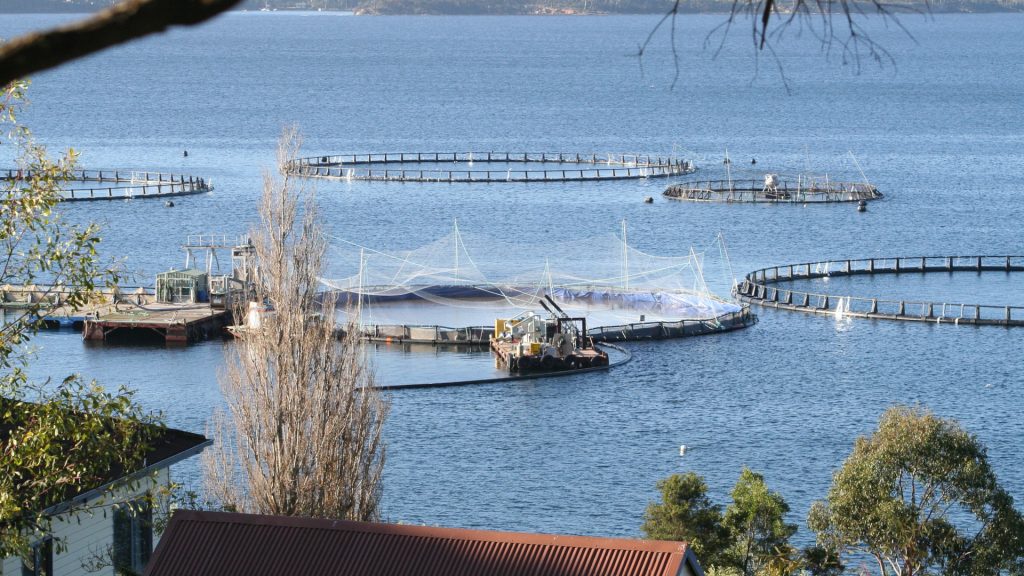
Despite claims to the contrary, aquaculture — the farming of aquatic plant and animal species — is not a sustainable or ethical solution to food insecurity or a sound alternative to terrestrial animal factory farming or to wild-caught fishing. Aquacultural systems perpetuate significant harms on animals, humans, and the environment. It’s time to unhook ourselves from misleading claims about aquaculture and from our own problematic perceptions and expose it for the atrocity it is — and better yet, restrict and regulate it before it’s too late.
As an attorney specializing in animal law, with a focus on the intersection of animal, human, and environmental rights, I’ve seen a massive body of evidence that aquaculture is among the most harmful activities on the planet. We need to address the industry now, as governments across the world are pushing for the harvesting and farming of aquatic beings with the “Blue Economy” as the governance catch of the day. Whether it’s the South African government Department of Forestry, Fisheries and Environment’s Operation Phakisa or the United States’ National Oceanic and Atmospheric Administration Blue Economy Strategic Plan, most of the world’s nations seem to have policies that promote aquaculture.
The rationale? Food security, economic benefits, employment, among others. But what if we’re opening Pandora’s box to release myriad potentially irreversible impacts?
Seeing the Fishes From the Seas: Scope and Scale
Aquaculture is the fastest growing food production sector in the world, having surpassed wild-caught fishing. In 2022 global production reached at a record high of 144 million tons (130.9 million tonnes) — and if you find it difficult to understand what that means practically, you’re not alone.
Unlike farmed terrestrial animals — where we count every individual creature we consume, kill, or effect — we measure our exploitation of fish and other aquatic animals by the tonnage, and for individual animals we rely on guestimates, which doesn’t give us a concrete picture. Estimates vary wildly: In terms of wild fishes, we consume somewhere between 3 billion and 6 billion per day, (between 1.1-2.2 trillion per year). For farmed fishes research places the number between 211 million and 339 million per day (between 29-149 billion per year). For shrimps alone, estimates are between 7.6 to 76 trillion shrimps per year (which combines both fishing and farming).
By comparison, approximately 80 billion land animals (of all species) are slaughtered each year for food — meaning that we potentially kill more than 7,590% more shrimp than all other land animals combined.
If we care about animal suffering — whether it’s terrestrial or aquatic animals — we should care about the scale and scope of the harm that’s occurring in aquaculture.
A Sea of Suffering: An (In)humane Industry?
Much like their farmed terrestrial counterparts, aquacultural animals are not treated humanely and are subjected to extremely cruel and harmful practices, perpetuating an array of animal-welfare problems.
Put simply, it’s no fun to be a farmed fish. Common conditions include mutilations, overcrowding, infighting, injuries, diseases, parasites, stress, depression, deformities, suffocation, food withdrawal, lack of enrichment, painful transportation, and cruel slaughter.
One example of a “normal” practice: Shrimps routinely have their eyestalks removed through crushing, cutting, burning, or tying them off (eyestalk ablation), because it increases spawning and shortens the maturation time for these sentient beings.
To many people the idea of caring about, or mitigating the suffering of, aquatic beings is laughable. While many care about the pooch at home — or even African elephants in the savanna — we don’t extend this consideration to aquatic beings (except for charismatic giants like whales, dolphins, and polar bears).
There are many reasons for this exclusion, including perceptions of water-dwelling animals’ intelligence, capacities, and pain tolerance; the fact that they live their lives largely unseen by us; they’re not “like” us (humans and other animals); we don’t understand them; or because we quite literally see them as only food. Perhaps we’ve fallen for the propaganda through constant assurances of “sustainability” on labels or carefully curated marketing. Regardless, we appear to have a strong moral disengagement when it comes to aquatic animals.
That’s why Dean Kathy Hessler of the Animal Legal Education Initiative and I created World Aquatic Animal Day back in 2020 to make these issues more visible. If we don’t grasp these biases, they’ll be further perpetuated through AI — an increasingly common tool in aquaculture.
Blurred Lines: Left Behind Legally
On top of all of these issues, aquatic animals are systematically excluded from legal protections.
The U.S. Animal Welfare Act excludes cold-blooded and farmed animals, meaning aquaculture animals are not included. Nor are they covered by the Humane Methods of Livestock Slaughter Act, the Twenty-Eight Hour Law, or many state animal cruelty statutes.
Even when state laws cover these creatures, and in the face of overwhelming evidence (including undercover investigations), prosecution is rare.
The current U.S. administration is further removing legal protections for aquatic beings, including depleted populations as well as aquatic habitats, under the guise of “Restoring American Seafood Competitiveness.”
In South Africa, the apartheid-era Animals Protection Act includes various terrestrial animals, but not a single aquatic animal is explicitly mentioned. While some have been included through litigation, the law doesn’t appear to have been successfully used for animals in aquaculture yet, even in the most severe instances of negligence and cruelty. Aquatic animals also aren’t specifically included in the Meat Safety Act (except for crocodiles), and the primary act regulating the use of aquatic animals is called the Marine Living Resources Act — talk about a statement of intent!
Casting a Wider Net: Broader Implications
Notably it’s not just the species directly farmed implicated by aquaculture — millions of other animals are exploited and killed in the process. For carnivorous animals (for example, salmon), other wild animals need to be either farmed or caught as “feed,” in what is known as “blue loss” (which has far-reaching implications). This means that fishing plays an intricate and essential part of aquaculture — including all the harms it brings (such as bottom trawling). Other animals, including insects, are also used as feed, something the industry aims to increase. Animals including cleaner wrasse fish are even removed from the wild and brought into production to eat lice (and reduce the threat of diseases they carry).
Even if you don’t connect with the animals affected, there are other reasons not to support aquaculture. From an environmental perspective it causes (water) pollution; release of antibiotics, pesticides and greenhouse gases; habitat loss and destruction; negatively impacts on ecosystems, wildlife (including threatened and endangered species) and biodiversity, (through escapements, invasions, diseases, inter-breeding and otherwise); and is extremely resource intensive.
If you’re still not convinced, there are potential human health harms due to the use of antibiotics and rise of antimicrobial resistance, contamination, toxicity, microplastics, mercury, and allergies. And aquaculture is an extremely high-risk job causing many diseases and injuries, and linked with another extremely dangerous job — fishing — not to mention the human rights abuses.
Despite this, another disturbing trend pushes to deregulate the industry in the United States and delegate aspects in South Africa. We should be trying to more strictly regulate harm and look at the issue from all perspectives.
Turning the Tide: Moving Forward
But there is some hope. Thanks to the tireless work of advocates, pushback is happening. Several U.S. states have pre-emptively banned octopus farming, with a federal bill in the works, and states like Washington have prohibited commercial finfish net pen aquaculture. Additional efforts include banning certain aquaculture activities in federal waters. Countries such as Norway have included humane slaughter provisions for aquatic animals, ensuring they are at least stunned before they’re killed. In the United Kingdom crabs, octopuses and lobsters are recognized as sentient beings. There’s increased litigation on misleading “sustainability” claims — even on pet food.
In South Africa many advocates (including my organization, Animal Law Reform South Africa) are working to enhance legal protections for wild and farmed animals, including aquatic ones. Recently we presented the High Court with arguments about the government’s obligations to consider the well-being of penguins in decision-making for the first time (a case that was ultimately settled out of court, for the benefit of both penguins and fishes). We’re also working to incorporate well-being as part of the Wildlife Well-being Forum, specifically the Task Team on aquaculture and fisheries (which I chair).
There are increasingly opportunities to replace aquatic animals with aquaculture for plants (like algae and seaweed, which also have climate benefits), and many plant-based seafood products exist. We are also seeing more dedicated efforts, organizations, courses, research, and publications creating more visibility and awareness for these issues.
Bottom line? It’s time to reexamine our own biases and recognize aquatic animals for who they are — sentient beings with intrinsic value — and to more consistently apply our moral caring and legal protections to them, including those who find themselves in factory farms beneath the surface.
Some of these issues were more fully ventilated at this year’s Oxford Centre for Animal Ethics Summer School, “The Ethics of Captivity,” including a focus on aquatic animals, and some of the work of the Aquatic Animal Law Project at George Washington University Law School. Watch out for an upcoming documentary and book on the topic of aquaculture from the Centre, and look for World Aquatic Animal Day 2026 to learn more. As consumers it’s important we educate ourselves as much as possible about where our food comes from. Support local NGOs working on these important initiatives and get involved where possible.
So long — and think of all the fish.
Previously in The Revelator:
Cash for Corals: Exploiting Ecosystems on Their Way to Extinction