This story was originally published by The Revelator. Subscribe to their newsletter.
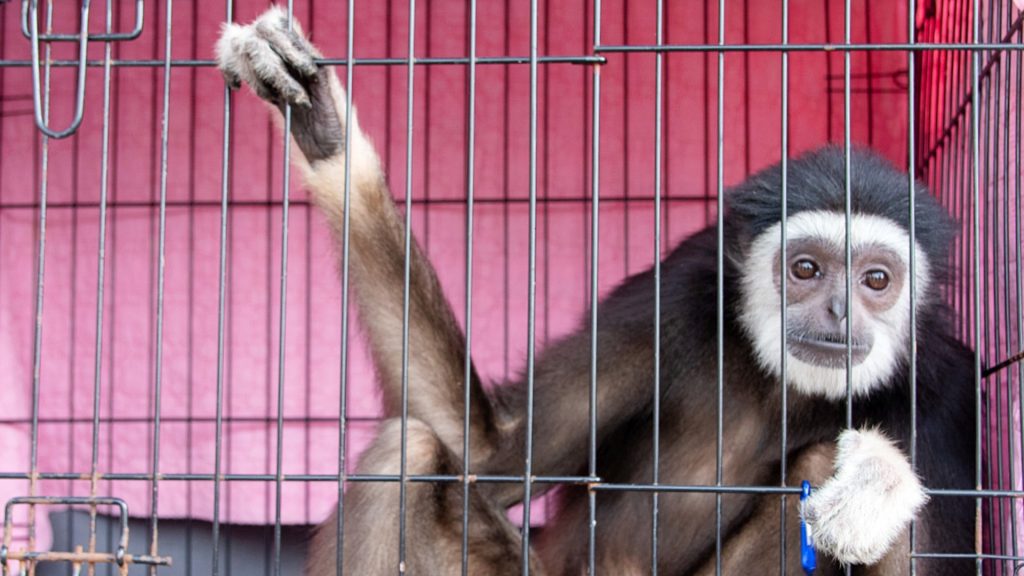
For well over a year now, the Save the Gibbons Alliance, a group of small-ape conservationists and media professionals focused on protecting these long-armed primates from illegal trade, has been tracking a worrying problem. They’ve documented at least one gibbon-smuggling incident per month, either at a southeast Asian airport or an Indian one, each involving multiple gibbon babies or juveniles. News reports of these seizures in the local media are often accompanied by heartbreaking images of distressed or dead gibbon babies, stuffed into check-in or carry-on baggage.
“The level of complexity and organization that needs to be involved in this is just huge,” says Dr. Susan Cheyne, senior lecturer in primate conservation at the Oxford Brookes University and a member of the Save the Gibbon Alliance.
Some months the number of seizure incidents has gone up to three or four. These confiscations have happened either during departure from Kuala Lumpur International Airport in Malaysia or from Suvarnabhumi Airport in Bangkok, Thailand, or upon arrival at various Indian airports.
This frequency of gibbon confiscations “is not something we’ve seen commonly in the past,” says Kanitha Krishnasamy, Southeast Asia director for TRAFFIC, a nongovernmental organization monitoring the illegal wildlife trade.
A recent report by TRAFFIC sheds light on the scale of the trade in the past decade (2016 – 2025). According to data they provided, some of which was collected after the report, 93 trafficked gibbons were confiscated across south and southeast Asia in 2025 alone.
“It’s the highest number of gibbons we’ve seen confiscated in the last 10 years,” says Krishnasamy. This number — which includes gibbons kept as pets as well as those being smuggled across international borders via air, sea, and land — amounts to a third of the gibbons seized in the previous nine years (2016-2024).
In the past decade, Indonesia has had the highest number gibbon-confiscation incidents and individuals seized, partly due to the robust domestic trade and in part due to increased attention by authorities. But more recently India and Malaysia have emerged at the heart of international gibbon-smuggling attempts.
According to TRAFFIC 33 gibbon-smuggling incidents were recorded in the past 10 years, most of which involved multiple animals at a time. Of these India was involved in 26 attempts as the destination (or possible mid-transit) country, while Malaysia was involved in 20 incidents as the source or transit point for gibbons trafficked from Indonesia and other southeast Asian range countries.
“In the past we’ve seen countless species from India being trafficked into the southeast Asian market,” says Krishnasamy. “We seem to be seeing something different now — gibbons and other mammals sourced from southeast Asia headed to the Indian market.
The Singing Apes
Gibbons are small, agile apes, found in 11 countries across Asia, from northeast India to the western islands of Indonesia. They are known for their loud, melodious calls known as “songs” that reverberate through forests. Of the 20 recognized gibbon species, the International Union for Conservation of Nature lists five as critically endangered, 14 as endangered, and one as vulnerable due to severe habitat loss and poaching for the illegal pet trade.
The two subspecies of siamang — the largest gibbons (in size) — are the most trafficked. “Over 30% of confiscations involve siamangs,” says Krishnasamy.
Other gibbon species that appear often in international trade include agile gibbons (Hylobates agilis), lar gibbons (H. lar), and Javan gibbons (H. moloch). “The majority of gibbons that turn up in trade are most likely to have come from Indonesia or Malaysia,” confirms Cheyne.
The Convention on International Trade in Endangered Species lists all gibbon species under what’s known as Appendix I, which offers them the highest level of protection and prohibits their commercial trade internationally. The apes are also protected under national law in their respective countries, making it illegal to hunt, capture, own, or trade them. If people are arrested and prosecuted for violating these statutes, punishment can include fines and years of imprisonment. Yet according to experts, enforcement remains woefully weak.
“There is a lack of capacity to take these cases to prosecution and to effectively investigate the trade networks,” says Cheyne.
What Is Driving the Demand?
Krishnasamy posits two reasons for the skyrocketing demand for gibbons from India.
“Either there is some sort of a fad of people wanting to keep gibbons as pets in India, or they are heading to facilities like zoos, safaris, or potentially even breeding facilities,” she says. “Which of the two is actually happening requires deeper investigation in India.”
She shares the example of the Teenage Mutant Ninja Turtles franchise, which influenced the turtle trade, or the Harry Potter series, which has led to an increase in the illegal trade in owls. “It’s hard to say what is driving this particular trend where gibbons are concerned,” she says.
Indian lawyer Pawan Sharma is the founder of Resqink Association for Wildlife Welfare, a rescue and rehabilitation facility located on the outskirts of Mumbai that provides medical care to the gibbons and other wildlife confiscated at the city’s airport. “We have seen more than 300 species intercepted at the airport, from anacondas to Komodo dragons,” says Sharma, adding that some Indians have a voracious appetite for exotic pets.
Online marketplaces provide a major platform for wildlife trade. Social media giant Meta recently shut down nine Indonesian Facebook groups — consisting of thousands of members — which were involved in the trade of endangered wildlife, including gibbons.
However, with criminals always staying one step ahead of the law, some traffickers have moved to more discreet modes of communication. Sharma cites the example of Google Pay being used by traffickers to talk to prospective buyers.
“A large part of the illegal wildlife trade is ultimately driven by human behavior,” says Cheyne. “It is, unfortunately, just another manifestation of the human desire for something different.”
Sourcing the Gibbons
Krishnasamy elaborates on the complexity of the trafficking process.
“It takes time, effort and connections to locate the gibbons in the forest, track them, capture them, transport them to middlemen — one or several — pack them and move them across international borders,” she says. “Not just at the point of exit from Malaysia or Thailand, but also identifying the people carrying and receiving them at the other end, and how to ensure safe passage,” she adds. “All this points to organized criminality.”
Female gibbons reproduce slowly and have a single baby once every two or three years. In most cases, mothers are killed to obtain infants. “If the group is without an adult female, it may allow an opportunity for a new adult female to come in or the group may break down,” says Cheyne.
Indiscriminate shooting could also result in the death of other individuals in the group. Rescued gibbon babies have often been found with pellets lodged in them.
“Ultimately there’s a knock-on consequence for gibbons in the wild,” adds Cheyne.
With a high death rate during the smuggling process, traffickers capture multiple gibbon babies from the wild for the transaction to remain profitable.
“They calculate that 90% of the gibbon babies will die,” says Sinan Serhadli, who is affiliated with two gibbon conservation projects in Asia. Even with this high mortality rate, the trade remains profitable for the traffickers, he adds.
Modes of Trafficking
In addition to trafficking by air, smuggling across international borders also happens by land and sea, which is harder to monitor.
“We’ve seen many cases of wildlife smuggling through land borders,” says Krishnasamy, who points to the Mekong region (which includes Thailand, Laos, Myanmar, Vietnam and Cambodia) and the Malay Peninsula (which includes southern Thailand and peninsular Malaysia).
The borders between India, Myanmar, and Bangladesh are also porous. Serhadli says about five western hoolock gibbons (Hoolock hoolock) are currently being rehabilitated at a facility in Bangladesh. They were confiscated from commuter buses and appeared to be heading to India.
The Strait of Malacca, a narrow stretch of water separating the island of Sumatra and Peninsular Malaysia, is emerging as another hotspot for wildlife trade, with Medan, a city in northeast Sumatra, becoming a key transit hub.
“A lot of wildlife from Sumatra is being brought to Medan,” says Serhadli. “It then goes over the Strait of Malacca either to Thailand or to Malaysia, and then via plane to India.”
In 2025 16 gibbon babies, along with dozens of other wild animals, were confiscated from a boat in the Strait of Malacca.
“This [seizure] is just the tip of the iceberg,” says Serhadli. Only three gibbons survived the ordeal and are currently undergoing rehabilitation at a facility run by the Orangutan Information Centre in northwest Sumatra.
Panut Hadisiswoyo, founder of OIC, says that he has spoken to Malaysian authorities about the urgent need to monitor the Strait of Malacca. “We need to work together to watch the Malacca Strait and prevent the wildlife trade,” he says.
The Next Steps
Krishnasamy wants people to realize that gibbon trafficking is a crime.
“It’s a well-planned illegal operation that harms not just threatened species, but also the carriers who are caught,” she says. These carriers are often low-income people, not those who profit most from the crimes. She hopes there will be increased cooperation between the countries involved, particularly on in-depth investigations.
In an effort to curb the increasing wildlife trafficking at Malaysian airports, TRAFFIC recently conducted a training session for nearly 200 frontline airport personnel to help them identify and respond to wildlife trafficking.
Reacting to the rise in wildlife trafficking via Indian airports, the Directorate of Civil Aviation issued a directive in July 2025 placing the full responsibility — including costs — of repatriating trafficked wildlife on the airline that carries the animals into the country. This has created additional pressure on inbound airlines to improve monitoring and checks. Lawyer Sharma confirms that the repatriations are already being done.
Still, many questions remain unanswered. What happens to the gibbons once they are sent back? Do they survive the repatriation process? Do they reach a rehabilitation facility, or do they end up getting trafficked again?
“Ultimately, we have to tackle demand,” says Cheyne. “There are people that take gibbons from the wild, there are those that sell them, there are those that buy them, there are those who live next to a forest and have them — it’s important to identify the different groups because they need to be targeted differently,” she adds. “If there’s no market for these animals, people will stop taking them out of the wild.”
Republish this article for free! Read our reprint policy.
Previously in The Revelator:
The Exotic Pet Trade Harms Animals and Humans. The European Union Is Studying a Potential Solution