This story was originally published by The Revelator . Subscribe to their newsletter.
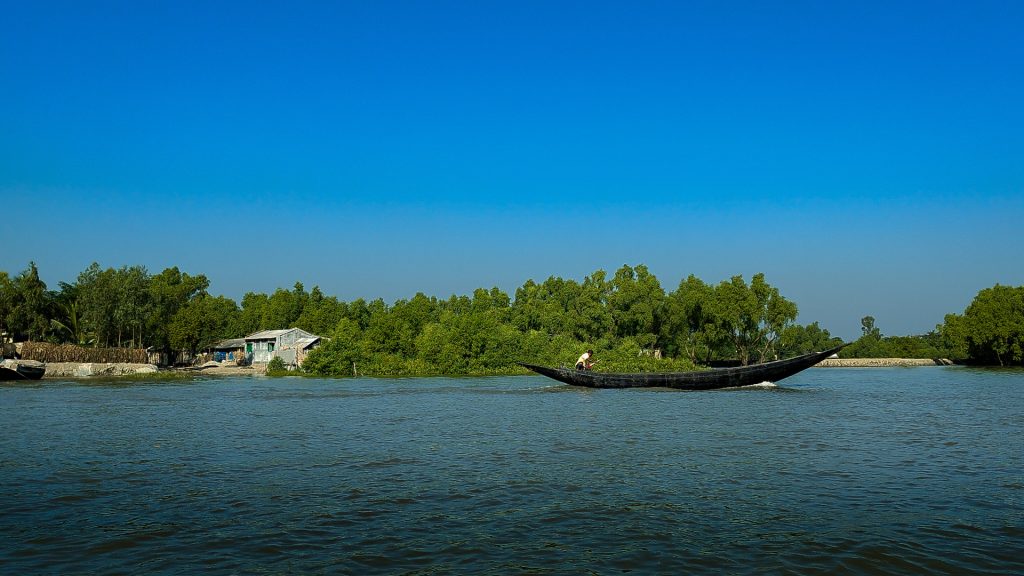
It’s the afternoon in Satkhira and the sun blazes down on the banks of Kholpetua River. The air hangs heavy, hot and damp, pressing down on the men gathered at Neel Dumur Ghat. They wait for the tide to rise, standing ankle deep in mud that clings to their feet like wet clay. Boats lie half afloat, half stranded, their wooden hulls patched and repatched, bearing the marks of years spent moving between river and forest.
I’ve been coming to this stretch of the Sundarbans — the world’s largest mangrove forest — for several years now, tracing how conservation rules and development policies shape everyday life along these riverbanks in Bangladesh. I return across seasons, when the forest is open, when it is closed, when livelihoods pause, and when they quietly continue anyway. Each visit reveals the same calculations being made along the riverbanks: who can afford to go into the forest, who cannot, and what risks are worth taking when alternatives have long since dried up.
The origins of that daily calculus stem from the arrival of an industry four decades ago that disrupted many people’s traditional links to the land and waters. More recently the arrival of essential conservation laws helped protect many endangered species in Bangladesh but further excluded people from systems that fed and supported them.
Now a new potential threat sits on the horizon: blue carbon.
Blue carbon, lauded in policy circles as an elegant solution to climate change, couples mangrove carbon sequestration with wealth generation. However, this idealized equation faces a harsh reality far from policy halls.
Forests That Feed
Beyond the ghat, where the mud banks dissolve into a web of canals, the Sundarbans begin. Not as a pristine wilderness, but as 2,300 square miles of living, breathing expanse of mangroves, tides, tigers, and people who have depended on it for generations. It’s a place governed by rules meant to protect it and by realities that often make those rules impossible to follow.
Among the men waiting for the tide is Manik Mia, 40 years old, his shoulders broad, his palms scarred from decades of pushing boats through tangled channels where saltwater laps at roots like restless fingers. For the past 24 years, he has followed in the footsteps of his father and grandfather, venturing into the mangroves to collect honey, fish fingerlings, and crabs.
Today, as the tide swells, Manik Mia readies for another journey, one that, like many others, is officially illegal. Like many others he earns income at certain times of the year as a mawali — a licensed honey collector who enters the forest during the short spring season, smoking wild hives from mangrove trees while on the lookout for tigers, hoping to haul a comb from the forest before the permits expire.
Since 2009 fishing, crab collection, honey gathering, and forest entry have been restricted at various times through much of the monsoon — seasonal bans intended to protect breeding cycles. Forest Department patrols maintain these rules with checkpoints and seizures if caught.
On paper these are conservation measures. But bans do not feed people. On the riverbank they also mean months when boats stay idle and pots stay empty. People like Manik Mia — along with an estimated 2.5 million others whose livelihoods are tied almost entirely to the Sundarbans — must decide whether survival is worth the risk of punishment.
As part of my fieldwork, I have listened to the same dilemma repeated across villages: The forest is closed, but hunger is not. Bans do not come with compensation or alternative work. Survival, instead, depends on defying the very regulations meant to protect the ecosystem.
Manik Mia tightens the rubber boots that he must wear to cross the treacherous mangrove forest floor, where every step can sink deep into the mud. He checks the pots that will be filled up with honey, the wooden stick he carries to beat the ground and startle any lurking tiger or wild pigs, and the handmade whistle used to warn companions if forest officers approach or danger arises. Around him his companions move with quiet precision, borrowing whatever gear they can: rubber boots, dried food, and firewood to smoke the bees.
Out here each tool is a lifeline; forgetting even one could mean difference between returning home safely or not at all.
“When your family is starving and you have no way to feed them except [foraging from] the Sundarbans,” Manik Mia says, pushing the boat into water that reflects the sky like liquid metal, “one does not really follow the rules. The need to feed your family is the priority.”
With the rising tides carrying them forward, the boat passes what locals call the “cemetery of boats” — a pile of wooden hulls stacked high behind the Munshiganj Forest Office. Each boat once belonged to a family whose source of livelihood was seized on charges of illegal entry or destructive fishing.
Confiscated and abandoned fishing boats lie rotting, half-sunk along a muddy bank of the Kholpetua River. Photograph by Tahura Farbin
“A fisher’s enemy is another fisher,” Manik Mia mutters, glancing at the abandoned boats. It’s not just the forest officers they fear. Often it’s other fishers who report them — sometimes out of rivalry, sometimes to protect canals poisoned by banned pesticides that kill everything in the water for weeks.
The snitching, born of desperation, reflects a cruel irony: Even as some fishers try to defend their shared forest and resources, they have no real authority or power to manage them. The state controls permits and bans yet offers no meaningful conversations or role for fishers and their communities in governance and management. As a result enforcement breeds fear, mistrust, and quiet resentment rather than cooperation.
This tension did not emerge by accident. It’s the outcome of decades of economic decisions that reshaped land, labor, and livelihoods along Bangladesh’s coast. Decisions that reduced farming, concentrated profits, and left forest as the last remaining safety net.
How We Got Here: The Shrimp Revolution
Manik Mia and his fellow fishers know this cycle well: the fear of losing the boat, the fines, the bribes, the humiliation — with the ever-present threat of life-changing injury or even death. Even in the face of these risks, the men vanish into a maze of canals, the air thick with heat, every ripple of water holding both promise and risk.
To understand why men like Manik Mia keep returning to the forest, we must travel back four decades.
Mohammad Ikram, now a farmer in his fifties, remembers the day the entrepreneurs first arrived with promises of wealth. Shrimp farming, they said, would transform the coast and the lives of the locals. Ponds would replace paddies; dollars would replace rice.
What Ikram couldn’t have known was that across the region, 220 square miles (57,000 hectares) of mangroves — nearly 10% of the Sundarbans — would vanish to make room for those “pink treasures” destined for distant plates in Europe and America.
The promises glittered — for a while. Big landowners and investors prospered as shrimp prices soared. But for small farmers and the landless, the costs piled up like the salt on their fields. Salinity rose, rice yields collapsed, and the work dried up.
Shrimp ponds dominate the landscape in Satkhira District, where rice fields were once common. Photograph by Tahura Farbin
“Having shrimp farms meant we were free, or at least had nothing much to do,” Ikram recalls. “In that free time, we went to the forest. Products from the Sundarbans were like profit without investment.” He explains that shrimp hatcheries, unlike rice paddies, need little labor once the ponds are prepared — no planting, weeding, or harvesting cycles that once kept families employed year-round. The shift from rice to shrimp left many without steady work, pushing them toward the forest to fill the gap.
He adds: The Sundarbans is business without capital; whatever you get is profit.
This is the paradox: An industry pitched as rural upliftment ended up deepening forest dependency. With farmland lost to salinity and with employment and incomes from farming lost, the forest became the only safety net.
“With paddy cultivation, we meet our needs for rice, fish, vegetables, even income from livestock,” he says. “We hardly have time, or need, to go to the forest anymore.”
His shift back to farming hints at a quiet truth: When secure livelihoods exist, the forest can breathe, too.
Revived rice fields glisten beside old shrimp ponds in coastal Bangladesh. Photograph by Tahura Farbin
The Bigger Picture: Blue Carbon Dreams, Fragile Realities
What is happening here is not a failure of conservation, but the success of a particular model of it, one now celebrated globally as “blue carbon.”
Globally Sundarbans is celebrated as a blue carbon powerhouse, a natural solution to climate change, storing vast amounts of carbon in its soils and mangroves. Policymakers and investors eye it as a jewel in the fight against global warming, a potential site for carbon credits and conservation dollars.
But on the ground Manik Mia’s reality collides with these ambitions. Conservation often means exclusion: bans enforced without alternatives, rules designed without communities, forests protected on paper while people are pushed into precarity.
It’s in this landscape that a fundamental challenge for blue carbon projects becomes visible. Conservation here cannot be only about carbon sequestration; it must also be about justice. Carbon credit frameworks that fail to confront the structural drivers of poverty, exclusion, and livelihood loss risk becoming global climate solutions at the expense of basic rights, denying local communities’ recognition, access, and meaningful voice in how the ecosystems they depend on are governed.
Without rights to access, use, and manage land or water, without secure incomes beyond the forbidden forest, the 2.5 million people that live locally may bear the cost of global climate goals.
Rethinking Conservation and Blue Carbon Governance
This paradox — where industries promoted for economic uplift, like shrimp aquaculture, deepen ecological degradation and forest dependency — demands more than well-intentioned conservation plans. The impacts of corporate shrimp aquaculture, large-scale conservation, and powerful blue carbon interests in the Sundarbans highlight the urgency of clarifying and protecting local peoples’ marine and forest tenure — including their rights to access, use, manage and determine the use of resources and space. There’s an opportunity, then, for the government- and forest-dependent communities to comanage — share power and responsibility in the sustainable use and conservation of the world’s largest mangrove forest.
This need and opportunity in the Sundarbans resonates with global calls for blue carbon projects, international donors, and investors to move beyond carbon accounting and genuinely embed social justice, tenure security, and rights-based safeguards into climate finance frameworks. International donors and carbon market investors should require rights-based safeguards and benefit sharing mechanisms so that revenues from carbon credits flow back to front line communities, rather than bypassing them for national coffers or private developers.
Furthermore, governments should ensure benefits flow to rightful communities and investment leads to communities that have both capacity and agency to navigate those markets. Intermediaries can work for communities and support project development, verification, certification, and sale of carbon credits in favor of communities.
Without these multi-scalar shifts, conservation in blue carbon ecosystems risks remaining well-intentioned but ineffective, overlooking the intertwined realities of livelihood governance and ecological survival.
The Sundarbans can indeed help mitigate climate change, but as Manik Mia reminds us, standing beside his boat and tangled mangrove roots: “Collecting honey and looking for tigers is the same thing. But we do it because we have no choice.”
Manik Mia moves cautiously through the dense mangrove forest of the Sundarbans. Photograph by Tahura Farbin
His words cut through the jargon of climate policy: Climate justice must begin at the margins, where survival, rights, and resilience are bound together.
Republish this article for free! Read our reprint policy .