This story was originally published by The Revelator. Subscribe to their newsletter.
Editor’s note: In November 2025 a United Nations report said the world was “off target” on its climate goals. This letter from the not-so-distant future explores the consequences.
I study ghosts. Not the spectral kind, but the mineralized, calcified ones. The latticed skeletons that once cradled a third of all marine life. In my lab I run my fingers over coral fossils the way an archaeologist might trace the shapes of a dead language carved onto a stone tablet. Each ridge and groove whispers of an ocean warmth that was once rhythmic, not relentless.
These aren’t fossils in the ancient sense. No Jurassic time capsule, no million-year tomb. The skeleton beneath my hand was alive when I was a young child. Its matrix of aragonite once pulsed with living tissue, symbiotic algal zooxanthellae glowing golden inside translucent animal skin. Now it’s a ghost of limestone: The architecture remains, but the tenants are gone.
We call this field Paleoreef Ecology. It was born in the decades after the final bleaching, the moment the living architecture of the sea became a memory. My students have never seen living coral reefs. They know them only from archival drone footage, museum holograms, and the bright resin replicas in museum exhibits labeled:
-
- The Great Barrier Reef (extinct, 2083)
- The Mesoamerican Barrier Reef (fragmented remnants, 2074)
- The Coral Triangle (functional collapse, 2081)
They ask what reefs were like, and I tell them “They were the rainforests of the sea,” alive with light and noise, each colony a living city, each polyp a beating heart in a nation of color.
I was once told that if I wanted to help people understand what had happened to the reefs, I should picture a museum of the greatest Expressionist art where the masterpieces were slowly being drained of color. Imagine Matisse’s The Dance, Kandinsky’s explosive compositions, and Munch’s The Scream, their dreamy colorscapes reduced to gray, empty outlines. At first the museum galleries remained full; visitors lingering before the fading canvases, trying to remember what once had been. But as the colors vanished, so did the crowds. With nothing left to see, the museum emptied.
That’s what coral science documented. As the coral died, the reef’s own patrons — the fish, the invertebrates, the entire living audience — departed. The once-busy galleries of the sea fell silent. To understand what scientists meant, you need to know the sheer magnitude of the color we lost.
The Mesoamerican Barrier Reef: The Wall That Fed Millions
Once, 700 miles of coral stretched like a living spine from Mexico’s Yucatán Peninsula to the Bay Islands of Honduras. It was the second-largest barrier reef on Earth, a wall that fed millions.
It fed them literally: Grouper, conch, and spiny lobster spilled from its shallows into the nets and hands of small fishers. It fed them economically: $6 billion a year in tourism, coastal protection, and livelihoods. And it fed them spiritually: The Maya regarded the coral reef as a sacred, protective, and giving realm that sustained their life and society. It served as the hallowed source of the materials that authenticated their most essential rituals and elite connections to the divine.
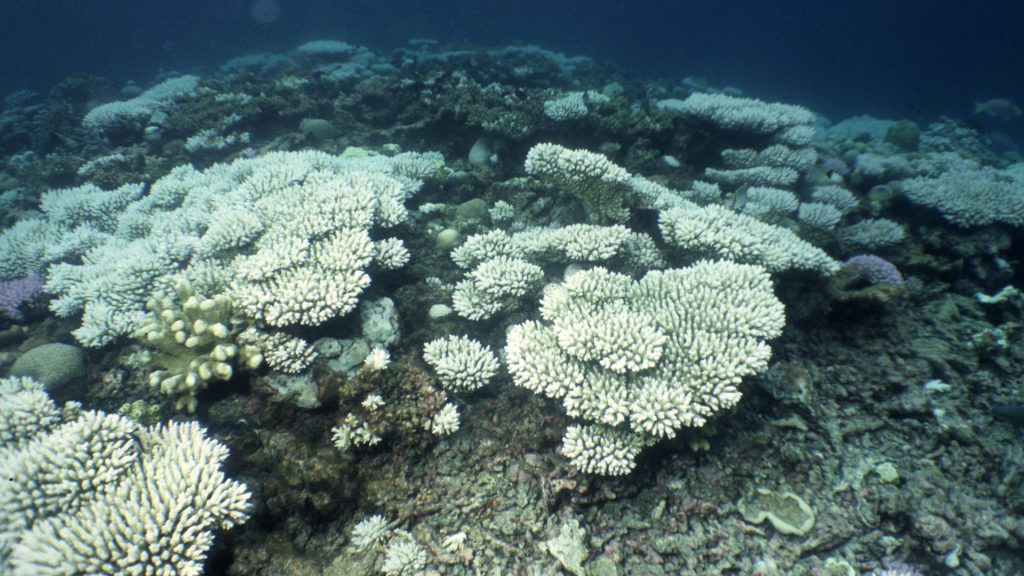
When the heatwaves began, first once a decade, then once a year, the reef flickered between brilliance and bone. In 2043 satellite imagery caught its final mass bleaching, a streak of white visible from orbit. The following hurricane season saw twice the normal levels of storm surge, twice the coastal damage. Without coral’s skeletons to blunt the waves, villages disappeared in a single night.
Now we core its fossilized remains to measure what was lost. Even in death its carbon record glows with the rhythm of its past resilience.
The Great Barrier Reef: The Long Unlearning
I still remember when the Great Barrier Reef was considered unsinkable. In the 2030s Australians fought like hell for it: cloud brightening, assisted gene flow, coral IVF. For a while they succeeded.
But as warming crept beyond 2.3°C, then 2.5°C, ocean heatwaves became relentless. The “super corals” bred to tolerate 32°C waters couldn’t survive the 35°C summers of the 2060s. Recovery intervals collapsed. Bleaching became seasonal, mortality inevitable.

By 2070 the reef was no longer a continuous ecosystem but a scatter of survivors, patches of hard coral clinging to deep ledges where currents ran cool. Dive tourism turned to memorial tours. “Reef diving” became a nostalgic phrase, like “glacier trekking” or “Amazon cruise.”
Economists called it the Great Unlearning, when Australia’s GDP retraction following the reef’s loss forced a reckoning that nature was infrastructure, not scenery. The reef had protected $20 billion in coastal property and 77,000 jobs. Once it was gone, the math caught up with the morality: The total economic, social, and cultural loss was $95 billion.
Fiji and Hawai‘i: Islands of Memory
Fiji’s reefs were once classrooms, grocery stores, and a village’s living bank; its capital held in fish and coral, its interest paid out in daily meals, ceremonies, and continuity. Fisherwomen read the tides as text, passing down ecological knowledge as songs that mapped spawning grounds and tabu closures. When corals bleached, these communities responded with patience and skill: rotating closures, community enforcement, and faith that the sea would heal if given time.
Time, however, became the rarest element. At 2.6°C, even the most resilient species — Porites lutea, Acropora muricata — couldn’t recover fast enough. Coral cover fell below the critical 10% threshold for self-recruitment. The reef’s collapse wasn’t dramatic; it was quiet, incremental, the way sleep takes over the exhausted.
In Hawai‘i the story is equally elegiac. The fringing reefs that once cradled honu (green sea turtles), filtered the waves, and generated nearly $1 billion in tourism now exist only in augmented reality. Children on Oahu swim above 3D-projected reefs in school swimming pools that track their movements, an educational simulation of what once kept their shores alive.
It’s beautiful. It’s unbearable.
Reconstructing the Impossible
We now model ancient reefs the way paleontologists once modeled dinosaurs. From isotopic ratios and historical heat maps, we can simulate how a reef “sounded” — the snapping of shrimp, the rumble of mating drums, the crunch of parrotfish biting coral. We can even recreate reef lightscapes, pixel by pixel: dawn gold filtering through branching Acropora, schools of pink anthias or cerulean chromis shimmering like breath.
Our data are exquisite. Our world is empty.
Sometimes I take my students to the core vault. We pass drawers filled with what used to be the foundations of paradise. We study the chemical traces of bleaching, of acidification, of loss. But I also remind them, these fossils record something else: the proof that life, when given the chance, resisted annihilation.
The Present We Could Have Changed
The record we left doesn’t indict the present; it warns it. In 2025 the UNEP Emissions Gap Report laid it out with chilling precision:
“Global warming projections over this century, based on full implementation of all Nationally Determined Contributions, are now 2.3–2.5°C. Meanwhile, nations are not even on track to meet their 2030 targets; based on policies currently in place, the world is heading for up to 2.8°C of warming.”
We told ourselves that 4°C was the line between catastrophe and collapse, that if we stayed below it, we’d be fine. But 2.5°C was never fine. It was the quiet erasure, the slow forgetting. It was the difference between reefs living and reefs remembered.
And yet, even then, there were strongholds still pulsing with life. But the greatest betrayal of the present was its failure to recognize the solutions already in place. Even at the edge of the abyss, pockets of life held on — a testament to local resilience and geography. Reefs that resisted, recovered, or simply refused to die: Fiji’s Lau Group, Tanzania, Indonesia’s Raja Ampat, the Chagos Archipelago, Palmyra Atoll, Tela Bay in Honduras, the Northern Red Sea.
They were not metaphors for hope; they were strategies for survival. Our last living proof that the future could still be rewritten.
Lessons in the Limestone
In the end I tell my students what I tell myself: Coral fossils are love letters written in carbonate. They tell us how hard life tried to stay.
Reefs were never fragile. They were adaptive, patient, endlessly inventive. It was our speed, the velocity of extraction, combustion, and denial, that undid them.
And so, when I hold a fragment of Porites in my palm, I imagine it still alive: ancient, massive, feeding, indomitable. I whisper the only apology that matters: You were beautiful, and we should have slowed down for you.