This story was originally published by The Revelator . Subscribe to their newsletter.
Liz Slooten couldn’t believe how many dead dolphins she was seeing. It was 1984, and the New Zealand-based zoology student was just beginning to study the smallest and rarest dolphins in the world. Now corpses were washing ashore in alarming numbers. Most were found entangled in fishing nets. For others, the cause of death was a mystery.
“We started asking the question, what the hell’s going on here?” Slooten remembers.
More than 40 years later, she’s still asking uncomfortable questions.
Recently retired from the University of Otago, Slooten is a leading expert on the endangered Hector’s dolphin (Cephalorhynchus hectori ). As of 2024, there are only 15,000 of these miniature dolphins left. A closely related subspecies, Māui’s dolphin (C. h. maui ), teeters on the brink of extinction with fewer than 50 remaining .
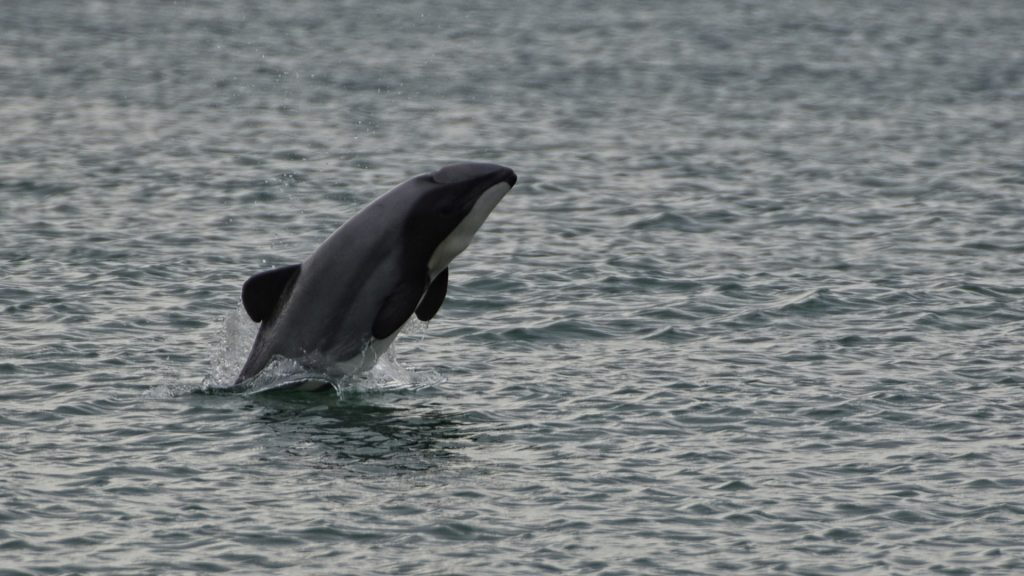
An endangered male Hector’s dolphin, around five feet long, jumps out of the water off the coast of South Island in New Zealand. Credit: Steve Dawson, New Zealand Whale and Dolphin Trust
There has long been debate whether Māui and Hector are separate species, but a 2002 study presented genetic analysis confirming that Māui is a subspecies of Hector’s with a bigger skull.
Māui live in the shallow water along the northwest coast of New Zealand’s North Island, at least 100 miles away from the home waters of Hector’s dolphins, in the shallows off South Island.
Both mammals still face the threat of entanglement from set nets and trawling, as fishing has grown into a multibillion-dollar industry in New Zealand, according to a recent report from the International Whaling Commission.
Established in 1946, the International Whaling Commission recommends conservation measures for both whale and dolphin populations. Its scientific committee also conducts population estimates on animals, including Māui dolphins, who are listed as critically endangered by the International Union for Conservation of Nature.
Just this March a dead juvenile Māui dolphin appeared along the shore of Port Waikato, a rural coastal town on the North Island of New Zealand just over 90 kilometers (56 miles) from Auckland. The remains were so decomposed that officials were unable to determine a cause of death and were initially unclear on whether it was a Hector or, as DNA later confirmed, a Māui.
“It was heartbreaking and really concerning,” says Christine Rose , the founder and chair of Māui and Hector’s Dolphin Defenders, a nonprofit dedicated to protecting both the country’s endemic dolphins. “We feel it in a visceral sense every time we get a report of a dolphin dying or being killed. Those small populations, with Māui in particular, it’s particularly tragic.”
Both dolphin subspecies, known for their fins shaped like Mickey Mouse ears, are protected under the Marine Mammals Protection Act passed in 1978. This New Zealand law works to preserve all animals in the country’s waters, prohibiting people from harming or killing them without a permit.
On-Board Monitoring
In October 2023, as Māui and Hector’s populations reached dire levels, New Zealand turned to alternative conservation methods by introducing electronic monitoring or cameras on board to watch for dolphins caught in nets.
That bycatch appears to be increasing. In the first year, fishermen reported 12 Hector’s dolphins found dead in trawling nets, later confirmed through camera footage. This is a stark increase: In the 30 years before cameras were put on board, onboard observers reported only two Hector’s dolphins in trawling nets and a single Māui caught in 2012.
The new figure may even be an undercount. Officials often rely on reports from fishermen before reviewing camera footage, and many fishermen do not report when a dolphin is caught, so bycatch numbers may be a conservative estimate, according to the International Whaling Commission report.
While fishermen are required to report when they find a dolphin in their net, they are exempt from “accidental capture.” They only face penalties if they are caught lying to officials in their report. Last March officials charged one South Island fisherman $5,000 after camera footage documented him cutting his nets and allowing a dead Hector’s dolphin to sink to the ocean floor. Initially, he told officials he had not caught any protected species.
This occurred years after the government declined to follow repeated advice from the IUCN and a request from the IWC to expand the no-net zone as far as 20 miles offshore and ban trawling in all dolphin habitats.
Despite calls to ban trawling in dolphin habitat, another former commercial fisherman, Nathan Hines, says, “As a fisherman, there’s never really any hate towards the dolphins themselves.” Hines started his fishing career by working on a wide range of fishing trawlers. During the past 10 years, he owned his own fishing vessel, where he was fishing the “heart of Hector dolphins’ habitat.”
“They’re always a highlight of my day,” Hines says. Lately, he’s been using dolphin acoustic deterrent devices , which are attached to fishing gear, releasing sounds and alerting marine mammals in hopes of reducing bycatch.
There are no requirements to use these devices in New Zealand, though.
Preserving the Subspecies
To try and push the government for stricter conservation efforts, a new generation of researchers is turning to genetic analysis, seeking better strategies for both dolphins. In a 2025 study , an Otago-based team reported it had sequenced the genomes of both dolphins and found no evidence they are interbreeding — an alarming conclusion for the much smaller Māui population.
“We’ve known that the Māui’s dolphin [has] been in trouble for many years,” says study co-author Sebastián Alvarez-Costes , a doctoral student at Otago. “Now we have evidence that they are completely separated. The authorities need the most evidence that you can give them about the populations to then act and protect them.”
Māui’s dolphins split from Hector’s as global sea levels began to rise after the last glacial maximum about 20,000 years ago, when the passage between New Zealand’s two main islands became too deep for the dolphins to comfortably traverse, according to the study.
Despite the extensive genetic evidence that Māui’s and Hectors are separate subspecies, Shane Jones, a member of parliament and the New Zealand Fisheries Minister, continues to deny Māui’s existence, a claim he first stated in 2020.
“There is no Māui’s dolphins,” Jones reiterated on NewstalkZB, a New Zealand-based radio network in September 2025.
That same month Jones implemented an overnight three-month blanket ban on set-net fishing along the Otago coastline on the Southern half of the South Island to reduce the amount of bycatch of another endangered species also endemic to the country, the yellow-eyed penguin , known as hoiho. He then extended the ban an additional nine months.
On the radio show, Jones said the issue of Māui’s conservation is different, because “there is no such thing,” despite evidence showing otherwise. Jones did not respond to The Revelator ’s request to comment.
Māui’s dolphins are slightly larger than Hectors and 40% less genetically diverse due to their isolation and small numbers, the study found. This makes them highly susceptible to the risks of inbreeding, including reproductive failure and diseases like toxoplasmosis. The International Whaling Commission report did find that the threat of toxoplasmosis, which killed two Māui’s dolphins in 2013, is declining.
The population is now so small, though, that “every single dolphin mortality is significant,” says Chris Parsons , an independent dolphin researcher who was not involved in the study.
The tragedies go beyond the dolphins themselves. They are regarded by the Indigenous Māori people as Taonga , a word meaning “treasure” that the Māori apply to anything that carries cultural significance.
“The Tribes have responsibilities of looking after the dolphins,” says Alana Alexander , a dolphin researcher and study author who has Tribal lineage and says this influences her work. “It heightens my sense of obligations to making sure that what I do is both useful for the dolphins but also for the Tribes.”
To try and push for better efforts beyond the conservation efforts that got their start in 1986 — largely based on research by Slooten, who was just starting her doctoral studies at the time — Rose’s group is now taking matters internationally. This January Māui and Hector’s Dolphin Defenders filed a lawsuit in the U.S. Court of International Trade to push the U.S. government to enforce the Marine Mammal Protection Act and ban the importation of seafood from any foreign fishery that harms or kills marine mammals in excess of U.S. standards.
Protecting these dolphins is a multigenerational effort. Back when Slooten first started her studies, her team autopsied 61 dolphins between 1984 and 1986. Ten were found on beaches with no known cause of death, and 51 dolphins were caught in fishing nets. Interviews with fishers confirmed the problem.
“It became immediately clear: There was no way that that was sustainable,” Slooten says.
The rules that Slooten originally helped instill have helped somewhat, slowing population decline, and the remaining Māui dolphins are younger, a median age of eight years old as of 2021 , a hopeful sign of population recovery, according to Rochelle Constantine , another study author. But overall population levels haven’t rebounded.
Part of the problem is that these dolphins, which researchers thought primarily stayed within seven miles of the coast, now stray as far as 20 miles offshore in some areas — beyond the government-determined protected areas — where they are threatened by all sorts of fishing-related activities, including gill, set and trawling nets, as well as seismic testing, mining, and tourism.
Future of Conservation
For Māui’s dolphins the situation has never been more dire. Even standard efforts like captive breeding may be too risky to implement, as the stress of capturing the animals can sometimes kill them, as it did during a tragic incident with critically endangered vaquita dolphins, according to Slooten.
Researchers say we need to stop using fishing nets in Hector’s and Māui’s habitat. If we do not, the ultimate risk is extinction, which could have cascading effects on food webs in coastal waters.
“You [are] basically removing one of the most important predators,” Alvarez-Costes says. “You are losing history and a species that is sacred for the local community.”
Hines says he thinks we could develop better deterrent devices. “I believe with the right research and the right money put into it, it wouldn’t be hard to get that interactions with Hector’s dolphins down to zero, and then everyone wins.”
It’s unclear if the government will move forward with these recommendations. A few months ago, Slooten and other researchers met and discussed the dolphins’ risk assessment. With their findings, they could implement new conservation efforts, but the next International Whaling Commission meeting isn’t until 2028, two years from now.
Māui dolphins do not have time to wait.
“They could go extinct at any time. They’re just treading water,” Constantine says.
Republish this article for free! Read our reprint policy .
Previously in The Revelator:
The Te Awa Tupua Act: An Inspiration for Communities to Take Responsibility for Their Ecosystems