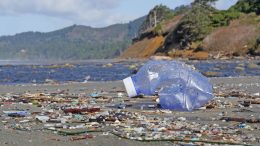
In 2019 a nonprofit called The Ocean Cleanup conducted a major test of technology designed to remove plastic pollution from the water.
It appeared to work, and the nonprofit released photos proclaiming its success.
But some scientists noticed something else among the accumulated plastic in the Ocean Cleanup’s publicity photos.
“Earlier this year I warned that @TheOceanCleanup would catch and kill floating marine life,” marine ecologist Dr. Rebecca Helm wrote on the social media platform then known as Twitter. “This week they announced they’re collecting plastic, and their picture shows HUNDREDS of floating animals trapped with the plastic.”
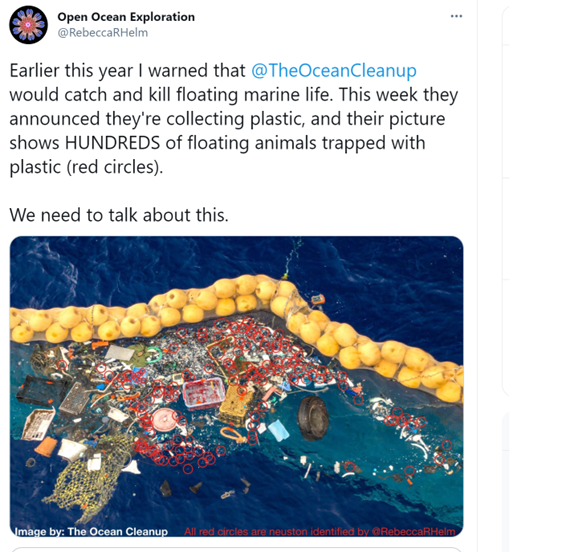 The Ocean Cleanup team appeared to be oblivious to this consequence of their test before this public criticism.
It’s not surprising that any attempt to remove plastic from here would catch, and likely kill, many marine organisms, because the waters of this region aren’t a trash-filled biological desert. The area is full of neuston, marine life that lives right at the sea surface — species that may not be as charismatic as dolphins or sea turtles but are extremely ecologically important.
“This region in general has very high densities of several key species,” says Helm, now an affiliate faculty member at Georgetown University. “This ecosystem is ecologically important to species that we do care about. We can’t just go disrupting it in the name of conservation and imagine that everything is OK and that you’re doing a good thing.”
Other scientists agreed.
“Honestly, if that was me, I would have totally stopped,” Dr. Kim Martini, a physical oceanographer and founder of the oceanography equipment designer and supplier Tini Scientific, says of the incident. “Because the whole point is supposed to be about how you’re saving animals that live in the ocean.”
But while Ocean Cleanup adapted — the organization claims its latest designs have a “low adverse impact” on ocean wildlife (something its own data contradicts) — it hasn’t stopped. It continues to conduct plastic-removal operations at great financial cost, garner worldwide publicity and social media attention, and attract millions of dollars of donations.
All for an idea that, almost from the day it was announced, scientists have warned could do more harm than good.
A Meteoric Launch
It all began in 2012, when Boyan Slat, an 18-year-old Dutch aerospace engineering student, gave a TED talk announcing a bold scheme to scoop plastic trash out of the ocean. Slat envisioned building what would be the largest human-made structure ever deployed in the ocean (by far), a device that would collect plastic from the Great Pacific Garbage Patch and remove it, saving countless marine organisms.
This idea has since attracted a loyal social media following and become a nonprofit that generates millions of dollars in donations a year, a fundraising and media juggernaut in the ocean conservation space.
What you wouldn’t know from most of the media coverage and social media posts is that experts in ocean plastic pollution and ocean engineering have long been skeptical of Slat’s model, raising concerns about a fundamental misunderstanding of the Great Pacific Garbage Patch and local ecology, a misunderstanding of why plastic pollution is a problem, and a lack of experience with the complex marine engineering required to pull off something like this.
That criticism and feedback haven’t dissuaded The Ocean Cleanup, despite the fact that to date it hasn’t accomplished what it set out to do, for exactly the reasons that ocean plastic pollution and ocean engineering experts said it wouldn’t work.
After building and testing expensive prototypes that led to failed tests — which failed exactly the way ocean plastic pollution and ocean engineering experts said they would — the team pivoted in 2019 toward a new model that was first suggested by critics and skeptics as an alternative in 2015. Now they mostly intercept plastic when it first leaves rivers and enters the ocean instead of trying to scoop it out of the middle of the ocean, though the open ocean work is still mentioned on their website and generates praise-filled uncritical media coverage.
Experts say The Ocean Cleanup’s history and current reality represent a useful case study in the role of evidence and expertise in solving complex global environmental problems, and why we should be skeptical of “Only I can fix it” public figures and their self-proclaimed revolutionary inventions.
Misunderstanding of the Background Issues: Ocean Plastic Pollution and the Great Pacific Garbage Patch
There’s no doubt that ocean plastic pollution is a huge problem. Some organisms ingest smaller pieces of plastic, which will either choke them, poison them, or block their digestive tracts (essentially filling their stomachs with items they can’t digest so there’s no room for actual food). Larger pieces of plastic pose entanglement hazards, immobilizing and drowning marine life. This plastic has been found all over the world, and thanks to patterns of global ocean currents, it aggregates in regions called gyres.

But when most people think about the ocean plastic pollution problem and the famous “Great Pacific Garbage Patch,” they picture a huge and dense plastic island so thick that you can walk on it. That’s not the case — it’s more like a soup full of tiny bits of plastic, sometimes so small that they’re invisible to the naked eye.
“If you go to the Great Pacific Garbage Patch, what you see is not a big collection of trash, but ocean, and it looks pretty normal,” says Dr. Miriam Goldstein, who did her Ph.D. on this region and is now the executive director of the National Ocean Protection Coalition. “When I was doing research out there, we were looking at many, many pieces of plastic — each about the size of a crumb.”
In any situation, if you don’t understand the problem, you’re unlikely to come up with a workable solution. For example, if you incorrectly believe that there are giant mountains of dense plastic floating in the ocean, it’s easier to wrongly believe that we can engineer a way to easily just scoop that plastic out of the ocean. It’s much harder to remove lots of tiny crumb-sized pieces of plastic … at least if your goal is avoiding killing everything else that’s swimming and living nearby.
“I was extremely skeptical of the whole idea, in part because the original TED talk was based on a fundamental misunderstanding of the Pacific Garbage Patch and gyres,” says Dr. Clark Richards, a physical oceanographer with Fisheries and Oceans Canada. “That’s the kind of picture that you get from introductory textbooks.”
It’s Hard to Build Things That Can Survive in the Ocean
A major reason why experts were skeptical of the Ocean Cleanup from the beginning was the team’s lack of experience with ocean engineering.
For one thing, the ocean is a rough environment, and it destroys human-made structures.
“You have a lot of concerns for any kind of instrumentation or large hardware that goes into the ocean,” says Dr. Martini. “Waves put a really large stress on anything mechanical. And you have issues with biofouling; anything you put in the ocean acts like a little raft and everything likes to grow on it, which makes it heavy and pulls it down.”

Dr. Richards also stressed the corrosive effect of seawater on anything metal and pointed out the complexity and expense of even getting a large structure in place.
“Equipment capable of being moored in the open ocean must be deployed from large capable offshore vessels, which typically cost about $100,000 per day,” he says.
In other words, there’s a reason why no one had built an object as large as the original vision for the Ocean Cleanup before, and it’s not because no one else had ever thought of it before.
“When I first saw the idea, I thought ‘This is very well-intentioned and heartfelt, but it won’t scale, it won’t work,’ ” Dr. Goldstein says.
At the time Goldstein and Martini, writing for the ocean blog Deep Sea News, performed a detailed technical review of proposed plans for the Ocean Cleanup, using their expertise to point out why the device could not function as claimed.
“We were trying to do them the courtesy of taking them seriously,” Dr. Goldstein said. “And also, as ocean communication people, we thought it was our duty to talk about this, since it was getting so much attention.”
Sure enough, a 2016 test run of a small-scale prototype broke for exactly the reasons Dr. Martini said it would and failed to collect a significant amount of plastic for exactly the reasons Dr. Richards said it would.
And by breaking, the Ocean Cleanup system itself became ocean pollution.
A representative for the Ocean Cleanup told me via email that they were receptive to expert criticism they received and made substantive changes to the design based on that criticism. The experts I interviewed for this article disagree.
More Issues
After fixing some of the structural issues, subsequent Ocean Cleanup designs began to collect small amounts of plastic trash — nowhere near the amount they claimed they were going to be removing and nowhere near enough to make a substantive difference — while also apparently killing enormous numbers of marine organisms.
Dr. Miriam Goldstein was not surprised by this.
“Yeah, that’s what happens when you try and catch things in that part of the ocean,” she says. “This was wholly predictable from a basic knowledge of that ecosystem — predictable and predicted. Our concern was a lack of fundamental understanding of both the oceanography and the animals that live among the plastic.”
A representative for the Ocean Cleanup acknowledged via email that their efforts kill some marine life but asserted that their research, published in the journal Scientific Reports, suggests plastic pollution kills more marine life than their cleanup attempts. They further claimed that “a majority of species caught as bycatch are invasive species.” The experts interviewed for this article did not agree with either claim.
The supplementary materials of their Scientific Reports paper, meanwhile, catalogued thousands of marine animals killed during Ocean Cleanup operations, including threatened species of sharks, bony fish, and sea turtles — none of whom are invasive. It found that 84% of animals identified as “incidental catch” in their cleanup efforts were fish, including three species of sharks. The paper also detailed how “Species classified as Vulnerable or Endangered, such as sea turtles (e.g., loggerhead, green and olive ridley), have also been encountered as incidental catch during cleanup.”
Pivots
Later designs of the Ocean Cleanup moved on from the free-floating boom and net design and transitioned into what it called System 002 and System 03 — essentially a large net towed behind a pair of boats. Ocean plastic pollution experts, once again, were not impressed. Despite the expenditure of millions of dollars, this new design was just slightly modified fishing gear.
“This organization was so focused on ‘technology development’ that they would adopt whatever they found and claim that they invented it, such as rebranding trawl fishing as trash removal technology,” Dr. Richards says.
In 2019 the Ocean Cleanup team also added a new element to their portfolio: trying to stop plastic from entering the ocean by intercepting it at river mouths.
While intercepting trash in this way is a good idea (and one that had been suggested by critics of earlier designs for years), the way they went about it left a sour test in many people’s mouths.
“The river interceptor design was clearly based on existing solutions” like Mr. Trash Wheel, Dr. Richards says. “Rather than work with the organizations who had successfully been removing trash from rivers for years, they ‘reinvented’ a similar design, at a much higher cost, and claimed to be innovators.”
A representative for the Ocean Cleanup told me via email that their river interceptors are custom-designed for each river.
Other Solutions
So if we can’t scoop all the plastic trash out of the ocean without killing large numbers of marine animals, what can we do instead?
One effective (and cost-effective) solution is the Ocean Conservancy’s International Coastal Cleanup. This amazing program has removed more than 400 million pounds of trash from beaches, where it’s much easier to access than in the middle of the ocean, before it gets swept back to sea. They do this at incredibly low cost, because more than 19 million people around the world have volunteered to help.
“Our total annual budget for all our plastics advocacy work, which includes cleanup, science and policy efforts, is about $6 million,” says Jordana Lewis, director of communications for the Ocean Conservancy Director of Communications. “Every organization contributing to the International Coastal Cleanup does things a little differently, but for every $2 invested Ocean Conservancy can remove a pound of trash from the environment and invest in scientific research and upstream policy solutions to prevent plastics from being produced and/or entering our ocean in the first place.”
As of this writing, The Ocean Cleanup reports it has removed 117.3 million pounds of waste from the ocean and (mostly) rivers. The nonprofit spent more than $72 million across its 2022-2024 fiscal years, according to tax filings.
Meanwhile Dr. Richards points out that in 2024 Ocean Cleanup’s System 002 “was out there spewing diesel fumes from a ship that cost $100,000 a day, picking up less plastic than a bunch of volunteers on beaches.” (A representative for the Ocean Cleanup told me via email that they are working on improving the cost efficiency of their operations.)
Ultimately the solution to the ocean plastic pollution crisis is going to be changes to our manufacturing and waste storage and treatment processes, which will take international agreements and lots of hard work. Or we could use less plastic — which would solve all these problems at the source.
Lessons Learned?
One of the most important lessons from this is that it shows the public understands the problems that plastic pollution poses to marine life — and that they’re willing to support solutions.
Unfortunately, it also shows how some people can take certain ideas too closely to heart — and take it personally when those ideas are criticized. When experts started speaking out about the Ocean Cleanup several years ago, I witnessed several of them endure online harassment from supporters of the organization, often phrased as “At least they’re trying to do something to help, all you do is complain.” (Note that this was being said to people who devoted their lives and careers to evidence-based solutions to cleaning up the ocean).
Another recurring theme was “You’re just jealous that someone solved a problem you didn’t.” (Of course, this was being said to people pointing out that the Ocean Cleanup had not solved the problem).
Ironically the criticism seemed to cause defenders to double-down on Ocean Cleanup.
“We were cast as the haters who just didn’t want to believe, and there’s a certain personality that sees criticism itself as validation that the idea is a good one,” Dr. Goldstein said.
Of course, sometimes when experts say something doesn’t work, it’s because it doesn’t work — not because critics are jealous of an idea.
Critically, trying to help is not the same thing as actually helping, and some popular solutions either make problems worse, or fail to solve them while squandering limited resources. For example, much “Save the bees” rhetoric focuses on nonnative honeybees and not the native species that are actually endangered; far too many well-intentioned online petitions aim to solve problems that have already been solved.
Dr. Helm, who worked on the United Nations High Seas treaty as a scientific advisor, knows how complicated effective solutions to complex issues really are. There are no shortcuts to putting in the work.
“There was this spirit at the time that a few well-meaning young people with a lot of passion would find solutions, but for complex problems like this one, the teenage geniuses and their billionaire backers aren’t going to save us, and they’re going to take us on a wild and expensive ride along the way,” Helm says.
Indeed, very few complex global problems will be solved by “imported magic,” a silver bullet technological solution that requires no one to make any sacrifices or changes.
Fixing these problems will require hard work, cooperation, expertise, and evidence. It may not make for snappy social media posts, but in the end, it’s the only thing that will help.

Previously in The Revelator:
Reflections on What Endures in Conservation