The phrase “All politics is local” was coined by former Speaker of the U.S. House of Representatives Tip O’Neill as a strategy for winning elections through the art and sometimes deception of message framing. Notably, in the trench warfare of political campaigns, framing separates the winners from the losers.
When it comes to forest ecosystems under unprecedented “active management” and climate stressors, proponents often dumb-down the treatments using the language of politics, optics, and euphemisms.
Applying O’Neill’s local politics framing in the context of “forest health” euphemisms can read this way: All wildfires and insect outbreaks are local politics; thus, active management is the solution to these forest-health problems otherwise exacerbated by lack of management. Further, if only foresters can get into all those “unhealthy” forests and perform active management (supposedly “benign thinning” in this case), the unhealthy forests will be healed. The unhealthiest forests are those where active management has been held back by forest protections, regulations, and so-called “analysis paralysis.” Protections and regulations are summarily gutted, and the public and scientists shut out of forest planning, so that managers can do whatever is best. End of story.
Proponents of such framing seem to take a page right out of George Orwell’s classic novel 1984 that introduced the concept of doublespeak, which is still relevant more than seven decades later. Orwell stated: “In our time, political speech and writing are largely the defense of the indefensible.” Orwell further waxed eloquently with “political language has to consist largely of euphemism, question-begging and sheer cloudy vagueness.”
Framing around thinning has Orwellian leanings, as for example, “tending the forest garden” (euphemism) as messaged by forestry groups, and a “healthy” forest is a thinned forest as messaged by the U.S. Forest Service.
Politicians also call for “fixing” the “broken forest” by legislating some of the same approaches that caused the damages in the first place. A most recent example is the so-called Fix Our Forest Act in the U.S. Senate that proposes massive logging increases on federal lands and restricts public involvement in forest-planning decisions in response to so-called “forest-health emergencies.” Such ill-informed proposals have the backing of even some conservation organizations (such as The Nature Conservancy and Environmental Defense Fund) and climate groups (Citizens’ Climate Lobby) that endorse calls for expansive thinning as risk-reduction to “catastrophic” wildfire without acknowledging the costs.
Thinning as the antidote to “unhealthy forests” is further exemplified by the proverbial question (as paraphrased from activist Steve Pedery): Thinning is the answer, so what is the question? Consequently, any side effects of treating substantial portions of a sick forest (the “patient” in this case) or “sick/unhealthy’” landscape (multiple sick patients) are seen as negligible.
The Ecological Story Is Much More Complicated
Based on our latest peer-reviewed paper on thinning in the journal Biological Conservation, we argue that much of the vagueness and hype surrounding forest thinning is based on deceptive framing, politics, and euphemisms that border on doublespeak. In pulling back the veil on thinning, there is much more to the story than claimed.
We take a hard look at the cost vs. benefits of thinning and show that costs often exceed benefits depending on intensity and type of removals (large vs. small trees), frequency of treatments (once and done vs. repeat treatments), scale of operations (single forest, across landscapes), and context (e.g., plantations and degraded areas vs. roadless areas and mature forests).
When Do the Benefits of Thinning Exceed the Costs (Thinning Works)?
There are a lot of reasons given by forest managers for thinning, including its traditional use in silviculture, and, more recently, in response to drought, wildfires, and increased water yield for reservoirs (covered in our paper). Under certain conditions, thinning can have ecological benefits such as treating small trees in recently logged stands to speed up (“leapfrog”) forest succession in ecological restoration efforts (e.g., as in the Northwest Forest Plan). However, the cost-benefit ratio has a tipping point (costs exceed benefits) as stands age and it’s simply not worth doing:
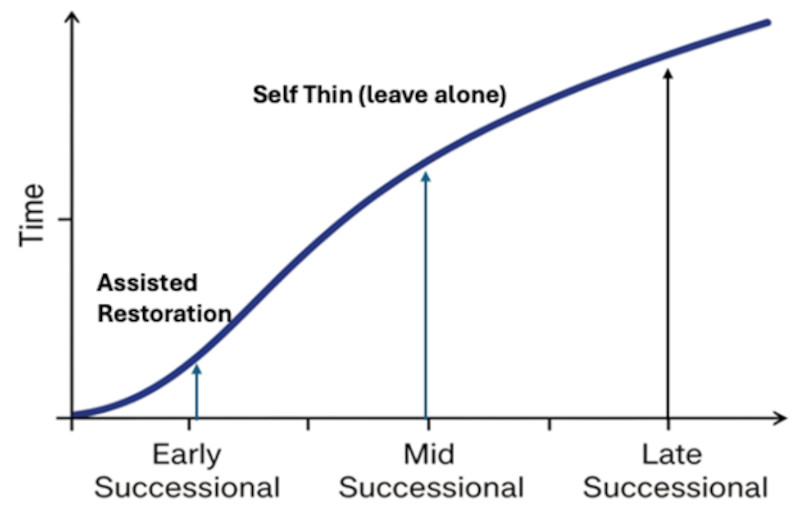
Thinning can sometimes reduce fire intensity, with a big “if” involved in its efficacy and costs that scale up depending on what’s removed. For instance, thinning works best under low-to-moderate fire weather and needs to be followed by prescribed burning, which is not the same as slash pile burning (see below). Prescribed fire and cultural burning practices alone may also have this reduced fire intensity benefits under certain conditions (i.e., it’s limited during extreme fire weather).
There is also a very low probability that a specific site treated will even encounter a fire in the short period when flammable vegetation has been reduced (after all, vegetation grows back). In response, managers scale up the extent of thinning to increase the odds of fire intersecting thinned sites but that will only accumulate impacts across larger areas (scale matters). For instance, thinning at large scales emits most of the carbon stored in forests overtime, contributing to global emissions that then feedback on more climate-change related insect outbreaks and wildfires. Thus, while some thinning operations can be ecologically beneficial, costs can often override the benefits.
When Do Thinning Costs Exceed Benefits (Thinning Doesn’t Work and Is Counterproductive)?
While some proponents of widespread thinning call for retention of “large trees” in thinning operations, the definition of large is seldom agreed and in practice can include old trees up to 150 years old, as in the dry forests of the eastern Cascades of Oregon and Washington.
Commercial thinning proposed for wildfire, drought, and insect resistance often removes large trees (“thin-from-above”) to pay for the overall treatment costs. In doing so, thinning has the most impact when it: (1) includes overstory removals including co-lateral damages to nearby trees from large-tree felling; (2) damages and dries out soils from solar exposure, heavy machinery (compaction), and burning of “slash” piles that concentrate intense heat on below-ground processes like mycorrhizae networks; (3) enables the establishment of invasive species (some of which are flammable) in disturbed soils; (4) degrades habitat for closed-canopy species and imperiled ones such as spotted owls; and (5) over-ventilates forests by leaving a few scattered “whip-trees” that act as “wind sails” easily uprooted by high winds — over-ventilated forests also lack wind buffering, leading to fast-moving fires.
In fact these impacts are not trivial as often claimed, since, according to research cited in our published article, thinning impacts when combined with natural disturbances on the same site often result in more trees killed than if that area were untreated and naturally disturbed leading to cumulative mortality losses.
In dry regions where droughts are increasing, there have been calls to heavily thin forests to increase water stored in reservoirs. But this comes at a steep price to water quality (sediment from runoff, especially roads) and the increase in water yield is temporary (less than10 years) as trees grow back, resulting in high costs.
And then there’s the issue of road impacts. To access sites for thinning, foresters need roads — lots of them. But roads are chronic disturbances that bring water-quality problems (sediment runoff that kills salmon egg-laying sites known as “redds,” for example) and wildlife mortality (vehicle collisions, poaching). Roads also serve as conduits for the spread of invasive species, chemical pollutants (spills), and human-caused wildfire ignitions. Such impacts can extend to over a half mile on either side of the road prism. As an example of severity of impacts, there are enough roads (~380,000 miles) on the U.S. national forest estate alone to circumnavigate the equatorial globe some 16 times.
Last but not least, to put this in financial context, thinning (not including road creation and maintenance) conservatively costs up to $840 per acre. The U.S. Forest Service in 2022 claimed it needed to treat 20 million acres on national forest system lands, with an additional 30 million acres of treatment on other landownerships (note that some treatment estimates are as high as 80 million acres combined). Using the 2022 estimate applied at this scale a single thinning entry would cost from ~$16.8 billion to $25.2 billion. Proposals also call for multiple thinning entries overtime, accumulating even greater costs.
It’s no wonder that thinning treatments are often paid for by logging large trees to make the projects supposedly financially viable.
Punching Through the Thinning Hype Involves Comprehensive Cost-Benefit Analyses
We are not “anti-thinning,” as our research shows there are benefits of thinning under certain conditions. However, those conditions are few and far between, with costs (ecological and financial) a function of treatment intensity, type of removals, scale, and context.
Additionally, we argue, large areas need to be set aside as off-limits (“no-go” zones) to thinning. Off-limit areas, for example, should include older (mature/old growth) forests, roadless areas, critical wildlife habitat areas, riparian areas, and other high-conservation value forests (costs greatly exceed benefits). On top of their conservation value, these areas can act as “controls” in thinning experiments designed as a tool for restoring degraded areas (plantations, heavily logged sites) in addition to rewilding measures like road ripping.
We also note that extreme fire weather will increasingly override thinning efficacy, creating even more pressure to treat larger areas aggressively (scaled impacts) for so-called “desired future conditions.” This is a kind of Sisyphus response as managers throw unprecedented resources at the effects of “forest-health emergencies” (wildfire and insect increases) rather than the root causes (logging, roads, climate change).
Our latest research includes 125 references, is comprehensive and balanced, and can help foresters assess cost-benefit ratios to determine when to thin (costs < benefits) and when not to thin (costs > benefits). It can also aid forest activists and decision makers in cutting through the euphemisms and the politics of forest thinning.
It’s clear to us that thinning has been overhyped by overzealous proponents who need to step back and examine the evidence of cumulative impacts regarding doing more of the same yet expecting a different outcome. Conservation groups endorsing thinning without comprehensive cost-benefit assessments should think twice about the consequences. Forest thinning is not an all-purpose cure-all. Despite examples where it can work, its commercial application is often counterproductive and costly.
Previously in The Revelator:
Logging to ‘Save’ Northern Spotted Owls From Wildfires Will Not End Well