
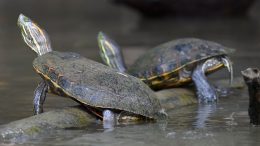
By the time Mexican turtles and tortoises arrive in Chris Rodriguez’s rehabilitation center in Southern California, most of them are in desperate shape.
“As with most illegally smuggled animals, they arrive dehydrated and often malnourished,” says Rodriguez. He’s the cofounder of Carapace Conservation, a rescue and rehabilitation organization specializing in trafficked turtles. “This stems from them being collected over a period of time and held in poor conditions until the poachers have enough animals to send.”
Rodriguez says the most frequently confiscated species trafficked through the Port of Los Angeles are box turtles and mud turtles. They’re prized by wildlife traffickers precisely because their colorful shells make them attractive to the pet market and their habits make them easy to catch in the wild.
And they’re not alone.
A Smuggling Frenzy
Every day traffickers pack imperiled turtles and tortoises into coolers, load them into personal vehicles, and drive them north through Tijuana and into San Ysidro, California — the busiest land border crossing in the world.
Mexico harbors the second highest turtle diversity in the world, with 48 documented turtle species, according to a peer-reviewed analysis published in the Revista Mexicana de Biodiversidad. This biological richness has made the Tijuana–San Diego corridor one of the most active entry points for illegally trafficked reptiles in the country, according to federal wildlife agents.
The Jalisco and Baja California regions sit at the center of this crisis, their extraordinary density of Chelonians (the taxonomic order that covers turtles) drawing organized trafficking networks that operate with the sophistication and impunity of criminal syndicates — because that is exactly what they are.
The scale of the problem came into sharp relief in late September 2025 when Mexican authorities executed coordinated raids across five locations in Jalisco and Baja California, confiscating more than 2,300 wild-caught turtles in a single sweep. What made the raid significant was the intelligence behind it: Multiple agencies worked in coordination across five locations simultaneously, which demonstrated a proactive, intelligence-driven approach that a 2025 study in Frontiers in Conservation Science found remains rare in Mexican wildlife enforcement. Responses to trafficking in Mexico are predominantly reactive, and law enforcement agencies frequently lack clarity on their specific responsibilities.
According to a December 2024 report by the International Fund for Animal Welfare titled Wildlife Crime in Hispanic America: An Analysis of Seizures and Poaching Incidents in 18 Countries (2017–2022), 1,945 seizures and poaching incidents were documented across the region during that period, involving a minimum of 102,577 wild animals. That only counts the animals who were confiscated and documented by authorities, not those who were successfully smuggled or died during transit.
The species disappearing into this pipeline are not generic “turtles.” They are some of the most ecologically irreplaceable reptiles in the Western Hemisphere.
The Mesoamerican slider (Trachemys venusta) is one of the most commonly trafficked species in Mexico and carries special government protection under Mexico’s Federal Attorney for Environmental Protection due to severe overexploitation of wild populations. The Central American river turtle (Dermatemys mawii) sits on the IUCN Red List as critically endangered, facing what researchers describe as widespread, dramatic, and ongoing population declines.
Rodriguez flags two additional species as his priorities right now.
“Our biggest concern out of Mexico is the Vallarta mud turtle,” he says, referring to Kinosternon vogti, a species found in only one waterway in small numbers, which is already appearing in illegal shipments.
At Carapace’s Madagascar program — a reminder that this problem is not exclusive to Mexico — the spider tortoise (Pyxis arachnoides) has emerged as a newer crisis.
“Adults are only around six inches, so they are the perfect size for smugglers,” Rodriguez explains. “Their small size means females only lay one egg at a time. This drastically increases the risk of extinction for this species if poaching trends continue.”
For animals who are seized and reach a facility like Carapace, recovery is possible, but far from guaranteed.
“It all starts with triage and quarantine,” Rodriguez says. “The animal needs to be evaluated immediately for injuries, external parasites, and disease until the vets are able to run tests. The animals stay in a quarantine area to prevent the spread of disease to healthy animals in our program.” Recovery timelines vary widely depending on each animal’s condition at arrival.
Reintroduction to the wild remains the end goal, Rodriguez notes, but comes with its own complex hurdles: international cooperation, safe monitored release sites, and protections to prevent trafficked animals from being collected again once returned.
Turtles in Crisis
The picture for turtles and tortoises is grim across the board.
“Populations across the globe are declining,” Rodriguez says, “with countries like Mexico and Madagascar being primary targets for smuggling due to a lack of funding for wildlife protection.”
When breeding adults — animals who may not reach reproductive maturity for 15 to 20 years — are stripped out of already-stressed wild populations, the damage doesn’t show up immediately. It shows up a decade later, when the next generation fails to appear and field surveys come back empty.
Scott Tregassar, executive director of The Biodiversity Group, a conservation nonprofit working across the American Southwest and Mexico, says the population-level consequences can be both immediate and catastrophic.
“In some cases it can be severe and apparent immediately, since someone, or a group of people, can collect enough mature individuals to disrupt the population dynamics overnight,” he says.
What makes tortoises particularly vulnerable, Tregassar explains, goes beyond simple numbers.
“Tortoises are fairly social creatures, and they suffer when their social group is disrupted. They know who their offspring are and they have a map of where all their neighbors, potential mates, and rivals live. In many cases, if even a single reproductive female is removed from a population, that could significantly reduce the population’s chances of long-term survival.”
Exploiting an Enforcement Gap
Traffickers don’t need drama; they need volume and consistency.
According to Kim Lovich, curator of herpetology at the San Diego Zoo Wildlife Alliance, animals move north from collection points across Baja and central Mexico. They’re then consolidated by regional distributors before crossing through San Ysidro in coolers, hidden compartments, and personal vehicles. A single seizure can carry 50 or more tortoises with a street value approaching $55,000.
From San Diego the pipeline extends further still. The San Diego Zoo Wildlife Alliance identifies LAX as the most-used port for shipping reptiles out of the U.S., bound primarily for China and Vietnam, where rare reptiles command premium prices as status pets.
In many ways turtles and other animals are just add-ons to make trafficking other illegal goods even more profitable. Mexico serves as the primary hub for a multinational criminal pipeline — sourcing wildlife from across the Caribbean, Central and South America — with transnational criminal organizations using logistics infrastructure built for drug, human, and arms smuggling to move exotic animals as a low-risk, high-margin side operation, according to a 2017 policy analysis by Rice University’s Baker Institute for Public Policy. And as Brookings Institution researcher Vanda Felbab-Brown has documented, cartels have also leveraged wildlife operations by supplying Chinese traders with animal products in exchange for the chemical precursors. These are then used to manufacture fentanyl and methamphetamine, making the turtle trade not just an ecological crisis, but a threat in a much larger and more dangerous web.
As The Revelator has previously reported, ports of entry remain chronically understaffed for wildlife inspection, and traffickers are sophisticated enough to know exactly when and where enforcement bandwidth runs thin. That enforcement gap is the story within the story. The U.S. Fish and Wildlife Service fields roughly 250 special agents to cover all wildlife crime across the entire country. Customs and Border Protection, meanwhile, directs every available resource toward fentanyl interdiction, firearms, and the Trump administration’s focus on migration that consumes the political oxygen in every border briefing. Wildlife trafficking doesn’t make the agenda.
The 2,300 turtles seized in Baja California last fall represent a moment of coordination that should be the rule, not the exception. For every animal confiscated, no one can say how many crossed undetected. The border stays open for business until wildlife crime earns the same urgency as every other form of organized crime moving through San Ysidro.
Right now, it doesn’t. And the tortoises are paying the price.
How to Help
Anyone considering buying a turtle or tortoise should ask for captive-bred documentation. Legitimate breeders can provide it. Animals sold without paperwork, at unusually low prices or in bulk, are red flags worth reporting to USFWS at 1-844-397-8477 or through the iWildlife app. Wildlife crime stays low-risk only because consumers don’t ask questions. That’s the one variable any of us can change today.

Previously in The Revelator:
Green Crime: Inside the Minds of the People Destroying the Planet, and How to Stop Them