
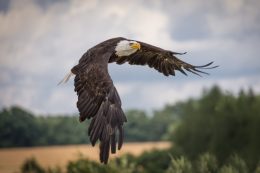
How quickly we forget — if we allow ourselves to.
For journalist Jason Dove Mark, bald eagles represent what the planet can lose, what it can regain, and what it can still lose in the process.
His new book, The Earth Said Remember Me: How to Revive Our Memories and Restore the Planet (W.W. Norton, published July 14), examines what scientists call “shifting baseline syndrome”: how we quickly forget the way things used to be.
For example, skies that once abounded with bald eagles — or the skies from which they once nearly vanished.
The Revelator is proud to present this excerpt from The Earth Said Remember Me. We don’t think you’ll forget it easily.
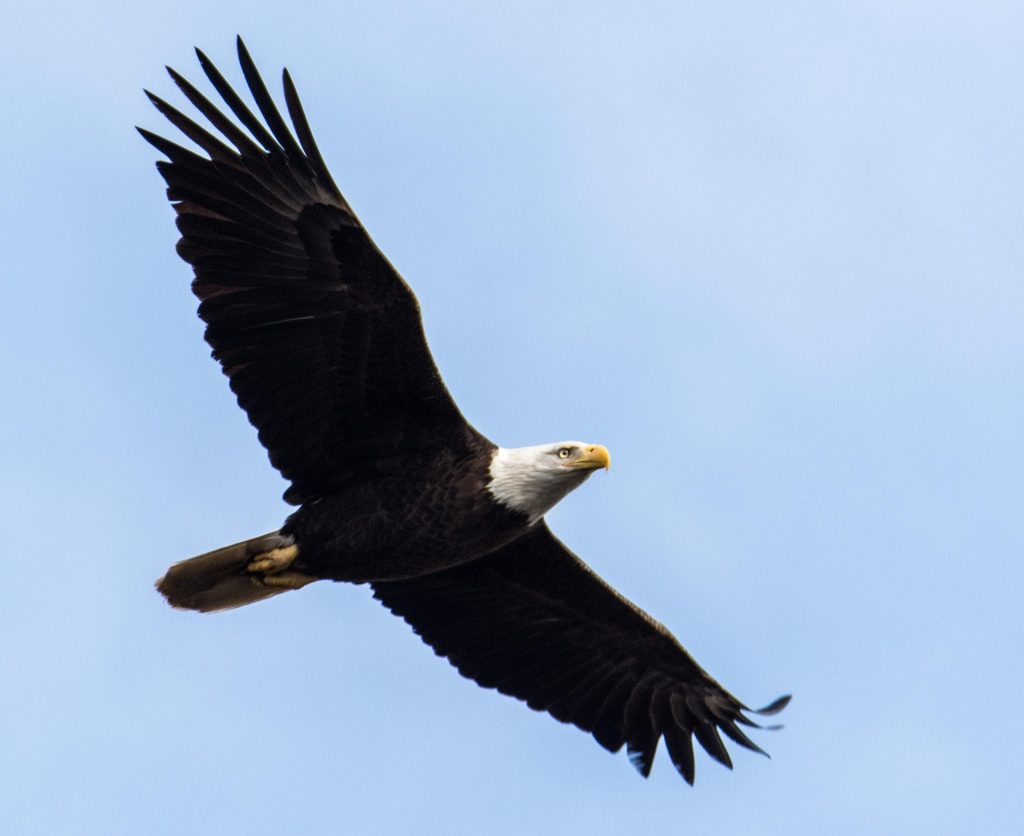
 For hundreds of thousands of years, during those long centuries when the New World was still old, bald eagles lived nearly everywhere in North America, their one and only natural home. Eagles flew over the tidal estuaries of the Atlantic Coast and the rugged seashore of the Pacific. They built their nests in the folds of western basin and range, on the prairie, throughout the north woods. There were likely a half million of them, an eyrie perched every few miles along fish-rich rivers like the Schuylkill, the Hudson, the Columbia, the Colorado. Up to 14 pounds in weight and with a wingspan that can stretch eight feet from tip to tip, the bald eagle was sovereign of the American sky, the apex predator of the air.
The First Nations perceived a great power in the bird. Many Native cultures considered bald eagle feathers as sacred and used them in ceremonies or for ritual healing practices. For the Lenape people of the Delaware River region, it was considered a sign of courage and good luck to wear an eagle feather that had been plucked from a living bird. In the Southwest, the Pueblo and Zuni kept domesticated eagles in large aviaries. Across diverse cultures, Indigenous lore esteemed the eagle as a chief, the bird of heaven. “In an eagle there is all the wisdom in the world,” the twentieth-century Lakota spiritual leader Lame Deer (aka John Fire) once said. “Eagle” was very likely the most common animal clan name continent-wide.
When the newcomers arrived from across the sea and encountered this bird they had never known, they also apprehended its strength. Perhaps it was just anthropomorphic projection. Bald eagles mate for life and carefully tend their young, and maybe the settlers imagined some kind of puritanical family values. Bald eagles also have a passion for building — their nests can weigh up to a ton and last for decades — and maybe the restless settlers appreciated the bird’s industriousness. At the very least, the new Americans liked the bird’s military bearing, with its steely gaze, broad chest, and bone-white crown. In 1782, the bald eagle became the central symbol of the Great Seal of the United States, the unofficial national bird — George Washington in feathers.
But it was a conflicted relationship. The eagle had become a symbol of America, yet many Americans didn’t like the actual animal. “He is a Bird of bad moral Character,” Benjamin Franklin famously wrote. “He does not get his Living honestly.” Franklin was referring to the bald eagle’s habit of stealing fish from the smaller osprey, its penchant for poaching, and its taste for carrion. Settlers complained that eagles often snatched their lambs and chicks. Against all common sense, the myth spread that bald eagles could carry off human babies from the crib.
A campaign of ecocide began. In the nineteenth and early twentieth centuries, Americans murdered eagles mercilessly. Farmers and ranchers shot them on sight — “We kill all the eagles we can,” one sheep farmer said — while some state and local governments paid bounties for dead eagles. In Alaska alone, hunters killed some eighty thousand eagles to cash in on the territory’s bounty. By the turn of the last century, the birds were vanishingly rare in most of the country. “Twenty years ago, I used to see a dozen or more along the river in the spring” the nature writer John Burroughs noticed in the early 1900s, “where I now see only one or two, or none at all.”
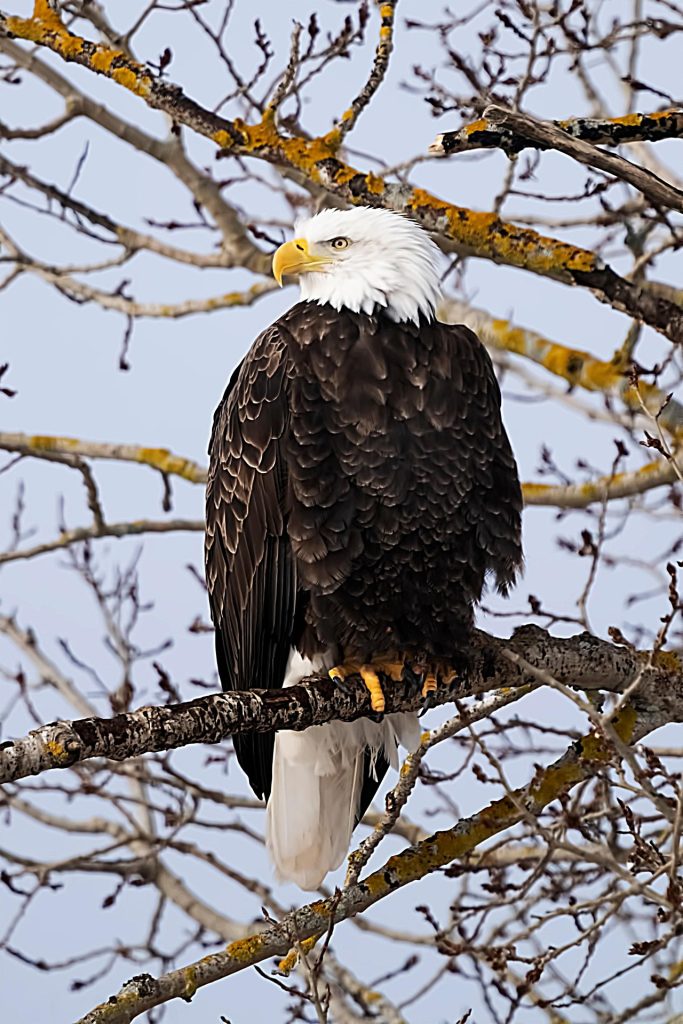
Eventually, the American public realized the country’s mistake. In 1940 the Bald and Golden Eagle Protection Act outlawed killing the bird. But the protection came almost too late. A new danger worse than bullets and buckshot threatened the species: the powerful insecticide DDT, which government agencies and farmers were spraying all over the place. The bald eagle — along with osprey, peregrine falcons, and pelicans — became collateral damage in the war against insects. DDT weakened the eagles’ eggshells and lowered females’ hormone levels, impacting the species’ ability to procreate. In Silent Spring, Rachel Carson wrote, “Something is at work in the eagle’s environment which has virtually destroyed its ability to reproduce. The reports differ in detail, but always repeat the theme of death.” By 1963, there were just 417 nesting pairs outside of Alaska.
In a spate of legislative urgency that these days feels like some-thing out of legend, lawmakers rushed to address the crisis. Congress banned DDT, which was pulled off the market in 1972. When the Endangered Species Act became law in 1973, the bald eagle was among the first species to come under its protective umbrella. The Clean Water Act helped too. An eagle can’t survive if it has nothing to eat, and by the 1960s many of the United States’ rivers served “as little more than sewers to the sea,” in the words of one senator. The Clean Water Act prohibited industries from using streams, rivers, and lakes as dumps for their chemical crap. Freed from pollution, the waters slowly came back to life. Fresh waters again furnished the food web.
The descendants of the destroyers became the restorers.
State fish and wildlife agencies launched captive breeding programs in which biologists, often assisted by volunteers, pantomimed the behavior of eagle parents to raise chicks. Using a technique called “hacking” that was already common among keepers of trained falcons, biologists reintroduced young eagles to lakes and rivers. Citizen scientists kept vigil over nests and helped count bald eagle numbers. Popular attitudes changed. For many Americans, to kill a bald eagle came to be something akin to burning the flag.
The heroic labor paid off. In 2007, the bald eagle was removed from the endangered species list. Between 2009 and 2021, the number of bald eagles in the lower 48 quadrupled, from about 72,000 to more than 300,000 — a figure not all that far from the estimated baseline before European arrival in the Americas. In the space of a couple human generations, the nearly extinct became common again.
It was as if the great hoop of time had spun all the way around. Once — that word that weighs the scales of every shifting baseline — could be used in celebration instead of lamentation.
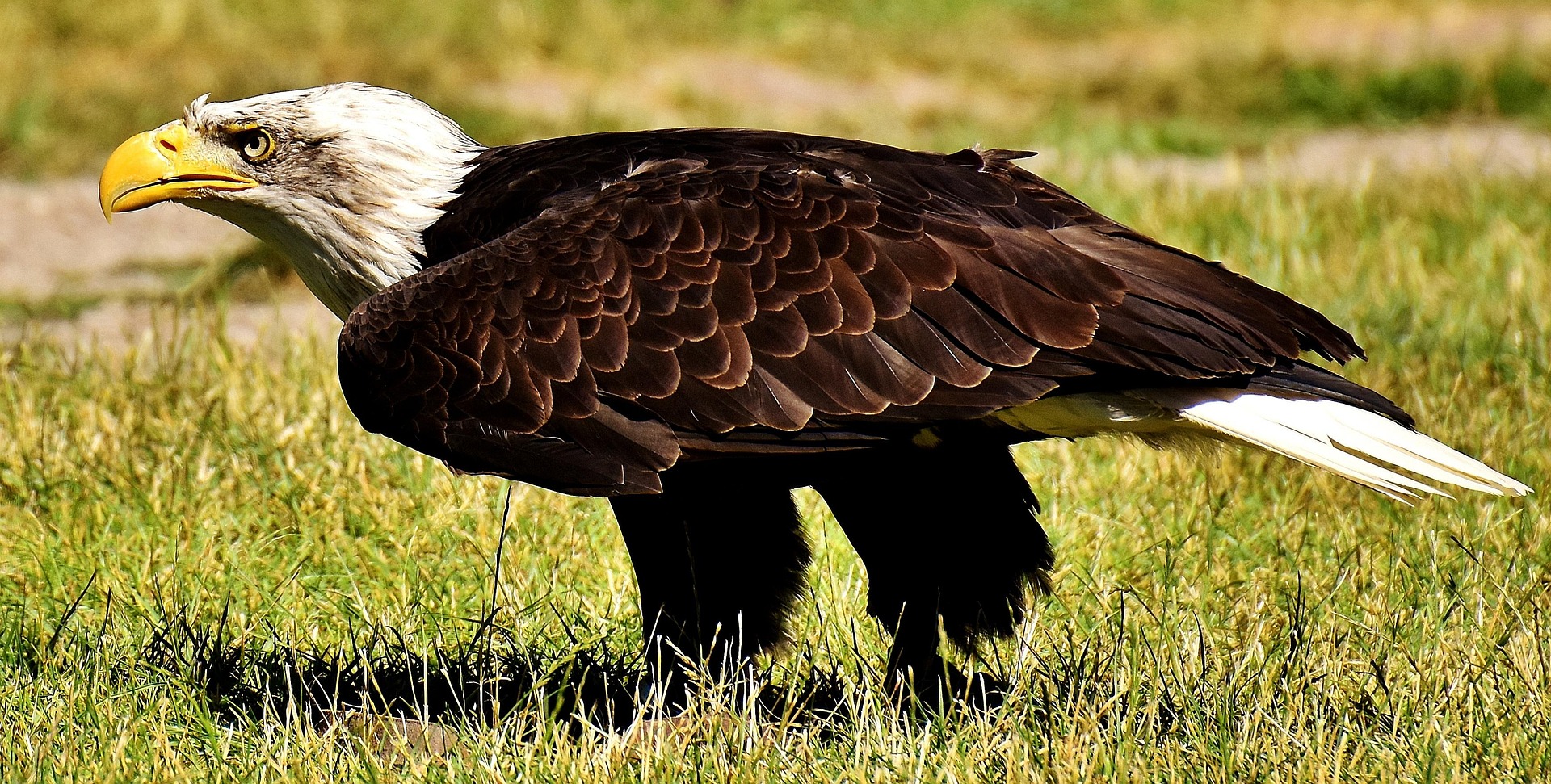
After an absence that stretched beyond memory, the bald eagles arrived at Madison’s Warner Park in the summer of 2020. Warner Park is one of the largest parks in the Wisconsin state capital, one of those jewel boxes of city nature that — like New York’s Central Park or Audubon Park in New Orleans — forms an eco-tone where the urban, the cultivated, and the undomesticated meet. Braceleted by the tracks of the Wisconsin & Southern Railroad, encircled by modest middle-class neighborhoods, and just a five-minute drive from the local airport, Warner Park is no wilderness. But it’s still a wild place, home to beaver and muskrat, deer and fox. An unruly copse — locals call it “the Big Thicket” — is packed with red maple, ash, and walnut. A massive bur oak, some 250 years old, has lived there since well before the first settlers appeared. Warner Park is one of those spots where people can watch wildlife and the wildlife are just comfortable enough with humans to watch back.
For the eagles, Warner Park had what they needed to make a home. When a mated pair began building a nest on an island in the park’s cattail-ringed lagoon, neighbors quickly spotted them. The birds became minor celebrities, symbols of hope in that eerie season of pandemic lockdown. “It was this brilliant beacon of light during a very dark time,” Beth Sluys, a Warner Park neighbor and amateur naturalist who had long been involved in local conservation issues, told me. “Observing the birds living their lives, there’s something magical about that.”
A neighborhood teenager named Elsie Olmanson who had started watching the eagles with her father after hearing about them from Beth also found joy in their arrival. “You’re happy that they are able to have a recovery, and that they’re coming more and more back into the world,” she told me. The eagles, she said, were “adorable creatures.” The nesting eagles seemed to her “like a married couple — they will bicker with each other.”
By the time of autumn leaf fall, the nest was impossible to miss: a lump of sticks and branches some thirty feet up, the whole mess wedged in the crook of two limbs, like a leather sofa had been dropped from the sky. The calendar flipped to 2021, and that March the bald eagle couple hatched a single eaglet. At which point a minor controversy broke out. Just a few hundred yards from the eagles’ home lagoon sits “the Duck Pond” — a small stadium that is home to the Madison Mallards, a collegiate summer baseball team. Every Fourth of July the Mallards stage a big fireworks display, and some of the eagle fans feared the fireworks would scare away the birds. A few folks petitioned the baseball team to halt the pyrotechnics or, at the very least, post-pone them until after fledging time. “We were concerned that this might potentially impact the fledglings at a critical time,” Elsie’s father, Eric, said.
Other eagle enthusiasts were nonplussed. Patrick Hasburgh, a passionate outdoorsman who owns a fishing bait and tackle shop on the edge of the park, was among the first people to spot the nesting eagles, and he felt like the fireworks controversy was overblown. “I’ve been watching the nest since it was built,” he told me, “and the eagles don’t seem to mind [human activity] at all. They are used to people. It’s an urban environment.”
In an age of mass extinction, the dustup over whether a fireworks show would disturb an eagle family seemed to me like something of a First World problem. Fifty years ago, there were just 108 eagle nests in all of Wisconsin; by the time an eagle pair started stacking sticks in Warner Park, that number had climbed to nearly 1,700. With eagle survival no longer in doubt, the question had become how best humans might help eagles to thrive. Here was another form of shifting baseline syndrome — an example of how progress, every bit as much destruction and diminishment, can be difficult to remember.
Too much of environmental history is a litany of losses. Ghost stories haunt the landscape: the passenger pigeon, the Tasmanian tiger, the ivory-billed woodpecker. But running parallel to the string of disappearances are stories of recovery and resilience. The bald eagle is not alone.
Think about the forests of North America: there’s more forest in New England today than there was in 1850. Consider the air and the water: both are clearer now than before the Clean Air Act and Clean Water Act were passed. Recall the beaver — now numbering in the millions across North America — or loggerhead turtles, whose population increased by nearly two orders of magnitude in the last twenty-some years. The California condor, at one point on the doorstep of extinction, is on the wing again. Take a breath and remember the whales, saved from annihilation. Seen from one vantage, many of those success stories could also be evidence of shifting baselines, of how our ideas of abundance contract generation by generation. Sure, there are more wolves on the American landscape now than there were fifty years ago — and there are also far fewer wolves than there were 150 years ago. But Mia Monroe, the co-founder of the Western Monarch Count, often brings up such wildlife recoveries as examples of the possibilities that also exist for her beloved butterflies. If we could save the bald eagle, what else can we save? “In my life I’ve watched the gray whale return and the peregrine falcon and the otter,” Mia told me once. “I don’t know what’s ahead for monarchs. But I do know that when people realized there was a problem, and we did something different, then nature responded. I always remember those examples.”
I remember them, too. They remind me that baselines some-times shift in virtuous directions. The British writer Robert Macfarlane suggests a name for this: lifting baselines. “We can normalize betterment as well as decline and then wish for betterment’s increase,” he has written. “We can run the reel backward.” The bald eagle’s comeback is proof that the passage of time doesn’t always mean loss and decay. Growth and increase are also expressions of time. So is healing.
There is, however, a danger that can come with lifting baselines and the normalization of betterment. To grow accustomed to abundance risks obscuring all the hard work and long years it took to achieve that abundance. Without collective memory, improvements can also be difficult to see. Rebecca Solnit made a similar point in an essay a few years ago when she warned that “forgetting is everywhere.” Solnit wrote that she feels like “a tortoise at the mayfly party,” and cautioned that “change itself becomes invisible when your timeframe is shorter than that change.” The indivisible present can cloak the march of progress just like it provides cover for the grind of destruction.
Environmental progress is especially vulnerable to becoming invisible since, more often than not, it leaves no trace. Many environmental victories are triumphs of harm avoided: the proposed oil pipeline denied, the forest kept free from the loggers, the fossil fuels unburned. Pollution, once cleaned from the air and the water, is another one of those absences that the mind struggles to recognize and remember. Without memory, environmental well-being is always at risk of being taken for granted. To endure, progress requires vigilance — the long view of history.
When I was growing up, the bald eagle was a rarity; the first time I saw one, I was in my mid-twenties. Now, I live in a place where bald eagles are common to the point of mundane. I make an annual winter-solstice pilgrimage to the North Fork of the Nooksack River, where bald eagles stage big convocations. From the small bridge there I can spot scores of eagles perched in the December-bare alder and cottonwood, their calls — skreee, like a door on rusty hinges — echoing off snow and ice. It’s a thrill to watch them scrimmage over salmon carcasses. For me, an eagle sighting never gets old.
My daughter has a different relationship to the bald eagle, especially having grown up in a place where you can spot them at the county dump (He does not get his Living honestly). She barely registers them as special, and she all too often greets her dad’s glee with an eye roll. What is a bald eagle to a child who has never known them as endangered? About as interesting as a wren.
I got a welcome corrective to these worries after spending a morning with the family of Patrick Hasburgh, the bait store owner who has been involved with the Southern Wisconsin Bird Alliance’s formal Bald Eagle Nest Watch since the mated pair showed up Warner Park. The Hasburgh boys — Fletcher, then sixteen, and Ranger, eleven — had spent count-less hours with their parents monitoring the eagles. But the commonplace had not dulled excitement. If anything, their regular eagle-watching had made them fascinated with the birds — appreciation earned through intimacy. Fletcher told me he “absolutely” knew the story of the fall and rise of the bald eagle, in part “because I have, you know, a kind of field knowledge.” Ranger, who was sporting a skater’s cut and an Off-the-Wall black hoodie, said he liked to “see the birds up close and see their whole life cycle.” He liked how, when he uses his dad’s spotting scope to check out the nest, he can “pretty much see every individual feather.”
We strolled the park, and the family shared with me some of its natural wonders: a killdeer nest on the railroad tracks, a pair of sandhill cranes coming in for a landing. The birds were like giraffes on the wing, tumbling earthward and honking madly. It quickly became apparent that the Hasburghs were involved in all sorts of neighborhood-scale environmental stewardship projects. Here was an ordinary American family who intuitively, organically, was embodying the antidotes to environmental amnesia — going outside in all weather and all seasons, emotion-ally encoding their relationships with the living world, writing them down, and transmitting their experiences back and forth between generations. This focus group of four seemed the very model of Emerson’s “practical naturalists.”
As a family, they go outside all the time. When Patrick and his wife, a nurse practitioner named Ashley, started a family, they committed to get their kids outdoors as much as possible because, as Patrick said, “they have more than enough reasons to stay inside.” The family made a point to visit every state park in Wisconsin. They hiked a lot, fished a lot. And they adopted Warner Park as their backyard wilderness. “This park has been a constant through my life,” mop-headed Fletcher said as we walked the paths not far from the eagle nest. “Now, when I’m going through this park, there’s a million stories.”
Over time, the family attuned themselves to the urban wildlife, began to notice things that other people seemed to miss: the cranes and the eagles, tiny frogs in the lagoon, a big snap-ping turtle laying its eggs on the railroad tracks. “For me, it’s one of those things where it’s like: Is it that I’m more aware, or are things changing?” Ashley said. “I see more nature than I remember seeing when we first started walking. Maybe I’m more in tune, or maybe it’s that it’s actually just kind of started becoming more wild. Or both. Probably both.”
The Hasburghs had made a record of their experiences in Warner Park. In addition to the eagle nest monitoring, Patrick enlisted the family in an initiative to protect the area’s bluebirds, believing that a formal citizen-science project would be a way of “sneaking some education in without it being their lame dad preaching to them.” On a weekly basis the family checked on eleven bluebird nesting boxes, evicted any sparrow squatters if necessary, and then sent to the Bluebird Restoration Association of Wisconsin information about the number of eggs and chicks. When he was a little kid, Fletcher had taken the work very seriously. Equipped with a clipboard, he studiously went from box to box making observations. “Pretty much half of my entire summer was spent just checking bluebird boxes,” he told me as we inspected one nest box that, it turned out, was empty. By now, Ashley said, the bluebird stewardship was “built into our lives.”
Both boys had become crackerjack birders who could tell a sparrow nest from a chickadee nest from a bluebird nest at a distance. They could see a bluebird chick and tell how many days old it was. With familiarity came emotional attachment: the family imprinted on the birds. “Maybe it’s just in my head, but you build sort of a relationship with them,” Ashley said. “I love it, and it’s fun to see, like, the evolution. And you kind of feel like, you know, a little mama bird.”
Passing on their naturalist knowledge to other kids was a big-ger lift. Fletcher — whose great passion is video games, especially Call of Duty — said he didn’t exactly advertise his conservation endeavors. “I don’t really want to have a big prom sign that says, Come to the prom with me — I look at birds.” And as much as Ranger was psyched about outdoor activities like fishing — the previous winter, he had caught a “monster” thirty-eight-inch pike and a twenty-nine-inch walleye — most of his free time was spent skateboarding.
If anything, the boys had passed their environmental passion not outward to peers but upward to their parents. Patrick said one of the reasons he had gotten into birds is because Fletcher, when he was very young, kept asking for their names. “And I wouldn’t have an answer,” Patrick said. “So then I got curious and then we started looking at other birds and we started a life list.” A child’s inquisitiveness, it turned out, could be a parent’s spark bird.
When we first spoke, Patrick told me that one his great inspirations was Aldo Leopold, whose writings he had been exposed to during a brief stint in college and who moved him to seek out “an engagement with the landscape.” It was A Sand County Almanac that spurred Patrick to start keeping a fishing journal, which turned into a birding journal, and then into an all-around phenology journal that is now entering its twenty-fifth year. “It’s mostly birds and animals and stuff like that,” he told me. “And at the end of the year I go through my journals and notes and send out a little report to friends.”
A famous line in Leopold’s canonical book comes as the author declares, “One of the penalties of an ecological education is that one lives alone in a world of wounds. Much of the damage inflicted on the land is quite invisible to laymen.” The Hasburghs’ tour of Warner Park made me think that maybe it was time to turn Leopold’s insight onto its head. Perhaps it’s equally true that one of the benefits of an ecological education is that one might, together with friends and family, inhabit a world of wonders. Much of the abundance that remains on the land is made visible by sharing it.
Isn’t this how the world might turn toward environmental progress, one workaday relationship with nature after another? The Hasburgh family was living proof that the task of ecological remembering isn’t necessarily difficult or esoteric; it can be as simple and as easy as a walk in the park. And as much as the Hasburghs demonstrated how to make memories of the living world, they also illustrated why it’s worthwhile to do all this physical, mental, and emotional work. Remembering isn’t about dwelling in the past, but a way of casting oneself forward in time, into the future tense. It was Ranger who helped make this clear. “I like just seeing the eagles and just watching the nest,” he said as we wrapped up our loop around the park and stood, again, not far from the eagle eyrie “That’s, like, a memory that will stay with me for a while.”