

Environmentalists, myself included, pay close attention to gloomy topics like species extinctions and Earth’s dwindling life-support systems. It’s not for the love of dark matters that we keep tabs on depressing metrics. Rather, it’s with the hope that they teach us something and guide us toward mitigating future losses.
On the biological front, about a million species could be taken by an extinction vortex by the end of the century. That’s also when linguists estimate about one-third of the world’s 7,000-plus Indigenous languages will go silent — and with them, most of their related cultures.
This is not uplifting news, to be sure. Nonetheless, people concerned with environmental protection can learn a lot from language extinctions. As it turns out, the survival of languages and species may well be linked. And when we wrap our minds around this, the panorama for conservation actually gets a little brighter.
A Confluence of Curious Similarities
Linguistic variation around the world caught the imagination and attention of naturalists going back at least to the Victorian era of exploration, when folks like Alfred Russell Wallace and Charles Darwin traveled across the wilds of South America and the Malay Archipelago.
Wallace marveled at the linguistic diversity shown by communities spread along the edges of the watery world in the Amazon basin and dotting the highlands of New Guinea. He even wrote out partial lexicons to aid in communicating with his guides. Darwin, in his ruminations on the descent of man, went so far as to remark that languages and species are “curiously the same.” He was thinking about human evolution and wondering if languages might evolve by natural selection. With his thoughts on the flowering of languages, he did not give time to their senescence.
It would take more than 100 years, after the concurrent publication of Darwin and Wallace’s theory of natural selection, for scientists to uncover the full extent of global linguistic variation, and also the languages’ risk of extinction. Today the patterns emerging from these discoveries hold lessons for environmentalists.
One of the pioneering explorations was conducted by Larry Gorenflo (Penn State University) and his team of conservation biologists and linguists. Their labors produced some profound findings.
First off, the places on Earth with outrageously high numbers of species also have outrageously high numbers of Indigenous languages. Furthermore, many of the species and languages of these hyper-rich spots are endemic. They don’t occur, much less co-occur, anywhere else.
Gorenflo and team went on to examine language diversity in regions that conservationists designate as “priority areas.” A second striking fact emerged: High-priority conservation regions are home to nearly 70% of the world’s languages.
These results demonstrate we can either win big or lose big, depending on the success of our efforts in these doubly diverse hotspots. It’s like playing a Daily Double, with “How to save life on Earth?” as the question to the answer.
Lullaby for Language
Extinction is forever. Except when it’s not. This isn’t a reference to de-extinction and the facsimiles brought into existence by technology. It’s about languages.
When the last speaker of a language falls into eternal slumber, so does their language. Linguists say that such languages are “dormant.” Dormancy is different from the extinction of biological species, at least in principle.
Sleeping languages can, hypothetically, experience reawakening. That is, they can be spoken again after a period of dormancy, but only under special circumstances. At a minimum there must be a written record of the lexicon and syntax. For instance, Hebrew came back in the 19th century after a long slumber.
Sadly, however, the vast majority of Indigenous languages only exist in the oral form, making linguistic resurrections nearly impossible. This is why dormancy and extinction are, for all intents and purposes, synonymous. It’s also why we must work to document and teach Indigenous languages before they nod off.
High Tolls for Both Languages and Species
Just as the vastness of language varieties was unearthed, the global decline became apparent as well. Nowadays researchers race to figure out what drives language endangerment. Lindell Bromham and Xia Hua (Australian National University) are two such investigators, who lead a large interdisciplinary team analyzing the subject.
In a recent cutting-edge study of massive scope and scale, the team uncovered the principal determinants that drive the downturn. One of the top three is strangely simple: roads.
“Greater road density, which may encourage population movement, is associated with increased (language) endangerment,” Bromham and team conclude.
You might say that roads compromise the linguistic intactness of a landscape. Conservation biologists, well versed in the dangers that roads pose to natural ecosystems, should relate to that.
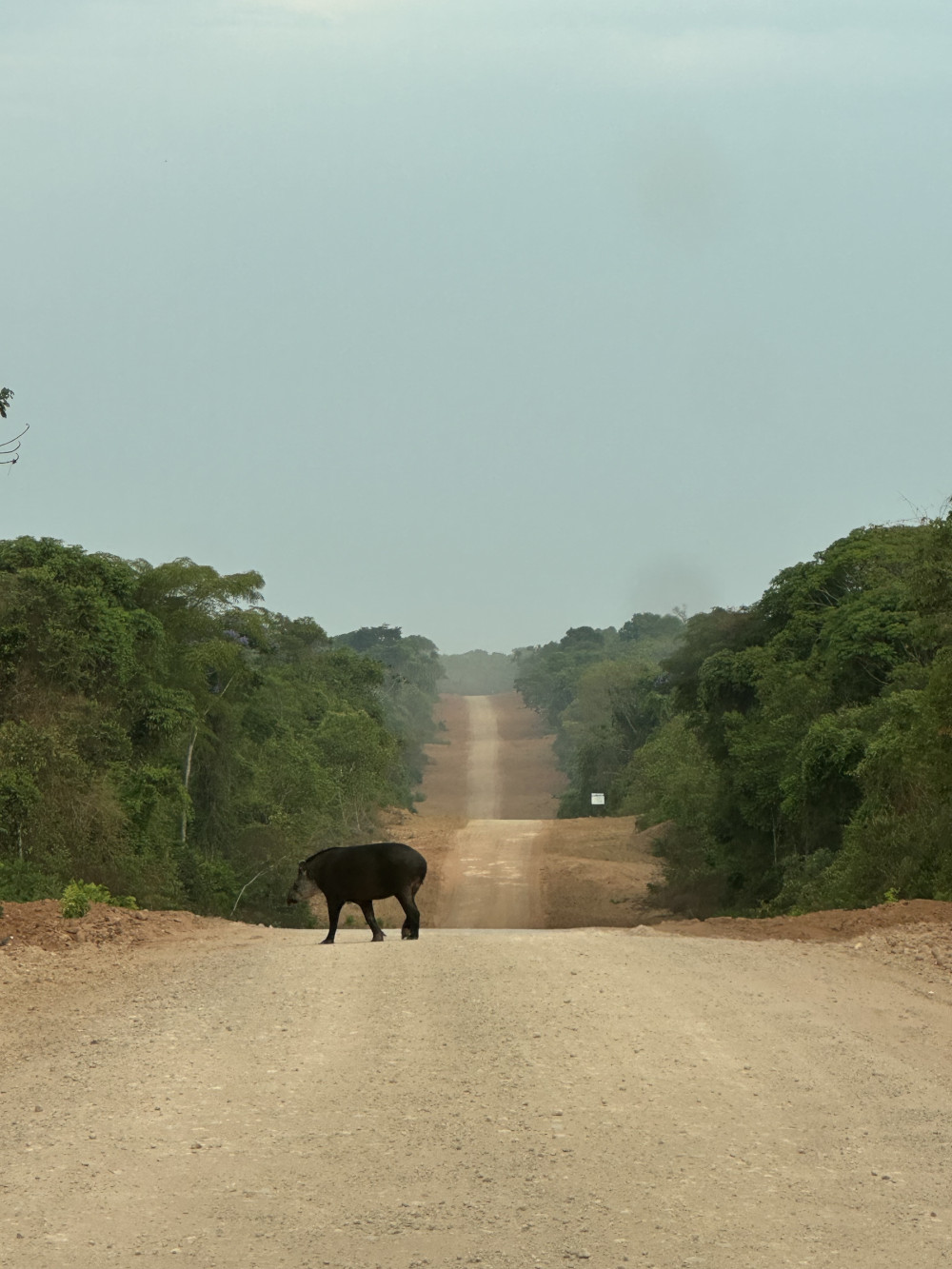
This is not to suggest that road effects are perfectly analogous in their impacts on languages and species. There are major differences. They have to do with the paradoxical capacity of roads to both create and destroy connections.
For remote ethnolinguistic groups, a frontier highway increases connectivity. Distances that once required weeks or more to cross may be traversed in hours or days. Lines of communication suddenly open — for material goods, of course, but also for the transmission of diverse ideologies and ways of life.
When this happens with high speed or without guardrails, a collision with cultural traditions and language preservation ensues. Often, such roads are the handiwork of large industries, looking to make money in the frontier, usually at the expense of local peoples whose lands they usurp.
One of the first casualties of enhanced contact is the local vernacular. This is a big blow to culture, potentially harming people’s health, wellbeing, and identity. The loss is accompanied by a shift to another language, usually the parlance of government, business, and education. A new sociocultural reality arises as the highway expansion continues.
By contrast, roads harm ecosystems by severing connections. Effectively, highways fracture natural populations and break the fundamental rules of ecology.
Renowned ecologist and conservation biologist Dr. William Laurance (James Cook University) tells me that bulldozing through forest expanses is like opening Pandora’s box.
“It’s because of the transformative effect that (roads) have,” he says. “They’re the single most important proximate driver of environmental change and degradation. A road goes in and six months later the forest is split open like a splayed fish.”
In distant lands, far from government regulation and oversight, a motorway quickly spawns ghost roads — unauthorized byways branching from the central transit spine. In short order, plantation monocultures flatten forests and open-pit mines erupt like infectious pocks. The cleavage of habitats puts native plant and animal populations at greater risk of declines, even extinctions. Curbside, roadkill piles up.
So while highways and their byways exert harm in different ways, they are nonetheless critical factors that must be reckoned with, for both conservationists and linguists.
We Don’t Need No Education?
The work by Bromham and team produced a result that may run counter-intuitive to every reader of this piece. Next to roads, say the investigators, the biggest threat to languages is formal education.
Educators may shake their heads, but there’s good evidence that Bromham and colleagues are right. They argue that monolingual education can lead to language shifts, with local Indigenous languages yielding to rising tongues. Young people, looking ahead to professional careers, may be strongly incentivized to adopt the language that advances their aspirations.
Various lines of evidence suggest this is, indeed, what happens. An example comes from Papua New Guinea, a tiny nation in Melanesia whose name graces the very top of the list of language-rich countries. That diversity is endangered, in large part, due to high school education, say Alfred Kik (University of Goroka) and Vojtěch Novotný (Czech Academy of Sciences). They’re long-term investigators in Papua New Guinea who have been documenting students’ Indigenous language skills and knowledge of local flora and fauna.
Their work demonstrates a “precipitous” decline in both. The result derives, they argue, from the push for children to learn English, which is used in schools and perceived to be the language of opportunity. The shift is also related to the spread of Tok Pisin, a type of pidgin English used extensively as the lingua franca in multilingual settings, including cafeterias and playgrounds.
The message is not that formal education should be eliminated for the sake of global linguistic diversity. The lesson, rather, is that the language of instruction, which is usually determined by education policy and funding availability, is highly consequential. Multilingual education is a possible antidote, especially in the context of environmental education.
Nature and Knowledge
K. David Harrison (Swarthmore and Vin University), an environmental linguist, emphasizes the “nature-centric” qualities of Indigenous tongues. They are distinguished, he writes, by the great diversity of words that describe plants and animals and the way that grammar encodes information about the world around them.
Harrison attributes nature-centrism to longstanding, intimate relationships between Indigenous speakers and their natural surroundings. It reflects a mindset in which people are part and parcel of nature, not separate entities.
For oral languages, words are key to the transmission of traditional ecological knowledge. This refers to a body of information and concepts held collectively by community members. As such, it is a living, evolving, and growing library that is honed and built incrementally over time and comes to life in use. When language goes extinct, so does the knowledge it holds.
The continued existence of ethnolinguistic groups in remote, harsh, and untrammeled areas is proof that knowledge and communication skills ensure sustainable ways of life. Gorenflo argues that, with a million species at risk of extinction, we should have regard for those who demonstrate a history of conservation success.
“Traditional ecological knowledge provides a glimpse into how people adapt to, and use, resources without destroying them,” Gorenflo tells me.
Along the same vein, Kik is racing against time to document the traditional ecological knowledge of the elders in the highlands of Papua New Guinea. He says it’s an effort to keep language and nature alive.
“Traditional ecological knowledge plays an important role in biodiversity conservation, sustainability, and natural resource management,” he tells me. “It plays a crucial role. If we lose language, we lose knowledge, and then there is a problem for environmental conservation. This will have impacts,” he warns.
Environmentalism, Language, and Culture
As we learn more from the results of interdisciplinary investigations, like those mentioned here, lessons for environmentalists emerge.
The first, of course, is to do more. Conservation biologists and linguists benefit greatly from cross-pollination, and the cause of language and species can profit, too.
In the meantime we know there are key action items that can be focal points for the short term. They include allocating the always-slender conservation monies toward diverse eco-linguistic landscapes, which are now well-documented by the mapping studies of Gorenflo and others.
Other priorities are to support the cataloguing of Indigenous languages and ethnobiological knowledge while speakers can tell their stories. In classroom settings, especially in locations where Indigenous tongues are still spoken, there should be real efforts to include multilingual programming, especially in relation to environmental education. Even better, where elders are able to share, their original voices should be heard.
Undoubtedly today’s environmentalists stand to derive great insights from supporting Indigenous groups in leading their own kinds of conservation. Most importantly, nature and knowledge will be the biggest beneficiaries. But first we must first embrace the idea that the extinction of languages and cultures is an environmental issue.

Previously in The Revelator:
Decolonizing Species Names