
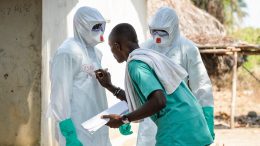
Ebola is once again making headlines and has been declared a Public Health Emergency of International Concern — the World Health Organization’s highest level of alert — after cases crossed the border from the Democratic Republic of the Congo into Uganda.
For many people this feels too distant to be of concern, but scientists and public health experts have been warning us that the conditions that allow Ebola and other diseases to spread from animals to humans have been building for decades.
Around 60% of known infectious diseases in humans are zoonotic (diseases that are transmitted between animals and people), and up to 75% of new and emerging infectious diseases have animal origins, mostly from wildlife. Nearly all WHO Public Health Emergencies of International Concern have been caused by diseases of animal origin: H1N1 (2009), Ebola (2014), Zika (2016), Ebola (2019), COVID-19 (2020), Mpox (2022 and 2024), and now this 2026 Ebola outbreak, which is spreading across the region at an alarming pace and scale.
To understand the potential threat, consider that the 2014–2016 Ebola outbreak in West Africa was the largest since the virus was reported in 1976. There were more cases and deaths in that outbreak than all others combined; more than 28,600 people became infected and 11,325 died.
This current outbreak is particularly concerning because this strain of Ebola (Bundibugyo) has no approved vaccine or therapeutics, and available diagnostic tests often fail to detect it. This means case numbers are very likely underestimated, and the true scale of transmission is uncertain. The ongoing humanitarian crisis in the region, high population mobility, including urban spread, and confirmed cross-border transmission create the perfect conditions for quick escalation. Ebola has devastating consequences once it infects people, with previous outbreaks recording case fatality rates ranging from approximately 30% to 66%, underscoring the importance of preventing spillover before it occurs.
How Spillover Happens
Fruit bats are one of the natural reservoir hosts, meaning they can carry the virus long term without becoming sick themselves. But it’s not just bats: Great apes, monkeys, duikers, chevrotains, pangolins, and other species are intermediate hosts, meaning they can carry and pass the virus on to humans.
It’s no coincidence that many of these species are also commonly hunted, traded, and sold in bushmeat and wildlife markets across Central and West Africa. Recent research by my organization, World Animal Protection, documented the pangolin trade on TikTok in West Africa and highlights how wildlife trade networks are increasingly operating both in physical markets and online, expanding opportunities for zoonotic disease spread. People who handle or eat the bushmeat can become infected through direct contact with the blood, bodily fluids, or tissues of infected animals, with the virus spreading through communities, person-to-person.
The risks are man-made and wholly preventable. When wild animals are captured, transported, confined, and slaughtered under stressful and inhumane conditions, we create the perfect storm for disease. At every stage of the trade chain, from capture and transport to sale and slaughter, wild animals are exposed to stress, injury, deprivation, and close confinement with other species they would rarely encounter in the wild. This weakens animals’ immune systems and increases opportunities for pathogens to spread between species, including to humans.
Why Habitat Loss and Wildlife Exploitation Matter
One major driver of Ebola risk is habitat destruction. When people clearcut or fragment forests for logging, mining, road building, and agricultural expansion, the chance of disease spillover increases. Studies of previous Ebola outbreaks (2004–2014) confirm that infection hotspots tend to occur in areas with greater forest fragmentation. As people gain access to previously undisturbed habitats, human activities such as hunting and bushmeat consumption increase the risk exponentially.
Commercial wildlife trade is another key driver of the high-risk conditions that produce spillover events. Wild animals transported across regions and borders, contained and slaughtered in markets with inadequate biosecurity and poor health conditions, and handled by people with little or no protective gear, pose an ongoing threat. Each time an animal is handled is an accident waiting to happen.
Species linked to Ebola spillover, including pangolins and primates, continue to be hunted and traded for meat and other purposes throughout the region despite the well-documented public health risks.
Although surveillance is a critical part of managing diseases, it only works when a disease is already present and people are showing symptoms. But with a disease like Ebola, this is already too late; by the time symptoms arrive, we’re playing catchup to limit further spread. Taking upstream action to prevent diseases from spilling over to people is the most meaningful way to prevent outbreaks and pandemics in the first place.
So here we are again talking about pandemic prevention. It’s significantly less costly than response in both economic and societal terms — a recent study estimates that a decade of pandemic prevention measures would cost around 2% of the economic damage caused by COVID-19 alone. Taking preventive action — including protecting habitats, ending commercial wildlife trade activities, and reducing human–animal interactions — is a smart, cost-effective investment.
From Evidence to Policy Action
The scientific community has been warning us of this growing risk for years. In 2020 the Intergovernmental Science-Policy Platform on Biodiversity and Ecosystem Services (IPBES) convened a panel of experts who concluded that land-use change, wildlife exploitation, and biodiversity loss are the primary drivers of pandemic emergence — and called explicitly for reducing the commercial exploitation of wild animals.
The report also reinforced growing scientific understanding that animal, human, and ecosystem health are inseparable. Poor treatment of wild animals is not only an ethical issue. It is also a public health issue.
Research by World Animal Protection has gone further, demonstrating that the commercial wildlife trade does not create isolated risks. Instead it generates feedback loops between poor animal welfare, pathogen transmission, ecosystem degradation, and governance failures.
Ending commercial wildlife trade — not simply regulating it or monitoring it — is what will break the cycle. If wild animals continue to be exploited, commodified, and transported through commercial supply chains, the conditions for future spillover events will remain.
At the international level, momentum has been building. The WHO Pandemic Agreement, adopted in 2025 after years of negotiation, recognizes the critical role of prevention and addressing drivers at the human–animal–environment interface. It also enshrines the One Health approach, recognizing that human, animal, and ecosystem health are interconnected — a landmark achievement.
For wildlife the impact is significant. Protecting forests and ending the commercial exploitation of wild creatures helps keep them within their natural habitats and can help keep them safer from disease and exploitation. For people, prevention not only saves lives but is far less costly than responding after an outbreak has begun.
Ultimately, if we want to save lives — of both people and animals — we need to look at doing things differently. Prevention is the only cure.
References
Amougou, C. V., Missoup, A. D., Tindo, M., & Gaubert, P. (2026). Systematic review of health risk assessment in Africa’s bushmeat trade: Are there any risks assessed? PLOS Neglected Tropical Diseases. https://doi.org/10.1371/journal.pntd.0014308
Assou, D., Elwin, A., Megson, D., Ping, X., Zeng, Y., Ketoh, G. H. K., Luiselli, L., Zhu, J., Segniagbeto, G. H., & D’Cruze, N. (2025). Viral threats: the role of TikTok in facilitating trade in CITES-listed species in Lomé, Togo. Nature Conservation, 59, 179–206. https://doi.org/10.3897/natureconservation.59.154465
Bernstein, A. S., Ando, A. W., Loch-Temzelides, T., Vale, M. M., Li, B. V., Li, H., Busch, J., Chapman, C. A., Kinnaird, M., Nowak, K., Castro, M. C., Zambrana-Torrelio, C., Ahumada, J. A., Xiao, L., Roehrdanz, P., Kaufman, L., Hannah, L., Daszak, P., Pimm, S. L., & Dobson, A. P. (2022). The costs and benefits of primary prevention of zoonotic pandemics. Science Advances, 8(5), Article eabl4183. https://doi.org/10.1126/sciadv.abl4183
Dobson, A. P., Pimm, S. L., Hannah, L., Kaufman, L., Ahumada, J. A., Ando, A. W., Bernstein, A., Busch, J., Daszak, P., Engelmann, J., Kinnaird, M. F., Li, B. V., Loch-Temzelides, T., Lovejoy, T., Nowak, K., Roehrdanz, P. R., & Vale, M. M. (2020). Ecology and economics for pandemic prevention. Science, 369(6502), 379–381. https://doi.org/10.1126/science.abc3189
D’Cruze, N., Green, J., Elwin, A., & Schmidt-Burbach, J. (2020). Trading tactics: Time to rethink the global trade in wildlife. Animals,10(12), 2456.
Finch, A., Gostin, L. O., Vora, N. M., Baylis, C., Dordelly Rosales, N., Hassan, L., Jamal, N., Niño, Y., Parravani, E., Pegger-Baur, T., Plowright, R. K., & Walzer, C. (2026). Elevating spillover prevention at the 2026 UN High-Level Meeting on pandemic prevention, preparedness, and response. The Lancet. https://doi.org/10.1016/S0140-6736(26)00557-X
Gruetzmacher, K., Karesh, W. B., Amuasi, J. H., Arshad, A., Farlow, A., Gabrysch, S., Jetzkowitz, J., Lieberman, S., Palmer, C., Winkler, A. S., & Walzer, C. (2021). The Berlin principles on one health – bridging global health and conservation. Science of the Total Environment, 764, Article 142919. https://doi.org/10.1016/j.scitotenv.2020.142919
Hussein, H. A. (2023). Brief review on Ebola virus disease and one health approach. Heliyon, 9(8), Article e19036. https://doi.org/10.1016/j.heliyon.2023.e19036
Intergovernmental Science-Policy Platform on Biodiversity and Ecosystem Services. (2020). Workshop report on biodiversity and pandemics of the Intergovernmental Science-Policy Platform on Biodiversity and Ecosystem Services. IPBES Secretariat. https://doi.org/10.5281/zenodo.4147317
Lee, Y.-W. (2026, April 22). Uganda cave predation and tourism drive Marburg spillover risk. ChosunBiz. https://biz.chosun.com/en/en-science/2026/04/22/AYHE53E3YFH3ZBMU5LDJEDR624/
Leendertz, S. A. J., Wich, S. A., Ancrenaz, M., Bergl, R. A., Gonder, M. K., Humle, T., & Leendertz, F. H. (2017). Ebola in great apes – current knowledge, possibilities for vaccination, and implications for conservation and human health. Mammal Review, 47(2), 98–111. https://doi.org/10.1111/mam.12082
Le Guenno, B., Formenty, P., Wyers, M., Gounon, P., Walker, F., & Boesch, C. (1995). Isolation and partial characterisation of a new strain of Ebola virus. The lancet, 345(8960), 1271-1274.
Lindenmayer, J. M., & Kaufman, G. E. (2021). One health and one welfare. In T. Stephens (Ed.), One welfare in practice: The role of the veterinarian (Chapter 1). CRC Press.
Olivero, J., Fa, J. E., Real, R., Márquez, A. L., Farfán, M. A., Vargas, J. M., Gaveau, D., Salim, M. A., Park, D., Suter, J., King, S., Sheil, D., Leendertz, S. A., & Nasi, R. (2017). Recent loss of closed forests is associated with Ebola virus disease outbreaks. Scientific Reports, 7, Article 14291. https://doi.org/10.1038/s41598-017-14727-9
United Nations Environment Programme & International Livestock Research Institute. (2020). Preventing the next pandemic: Zoonotic diseases and how to break the chain of transmission. UNEP. https://wedocs.unep.org/items/426976c7-ee73-4cd8-a3f2-8659d1e88b04
Vora, N. M. (2022, November 16). Hunting for the next pandemic virus. Microcosm. https://asm.org/magazine/2022/fall/hunting-for-the-next-pandemic-virus
World Health Organization. (2016). Ebola outbreak 2014–2016 – West Africa. https://www.who.int/emergencies/situations/ebola-outbreak-2014-2016-West-Africa
World Health Organization. (2025). WHO Pandemic Agreement (Resolution WHA78.1). Seventy-eighth World Health Assembly. https://apps.who.int/gb/ebwha/pdf_files/WHA78/A78_R1-en.pdf
World Health Organization. (2026, May 17). Epidemic of Ebola disease caused by Bundibugyo virus in the Democratic Republic of the Congo and Uganda determined a public health emergency of international concern [News release]. https://www.who.int/news/item/17-05-2026-epidemic-of-ebola-disease-in-the-democratic-republic-of-the-congo-and-uganda-determined-a-public-health-emergency-of-international-concern