
Why don’t more people talk about chameleons?
These amazing reptiles come in all sorts of shapes, sizes, and colors, and are known for their color-shifting abilities and unique eyes, which can look in two different directions at once.
But not enough human eyes are paying attention to chameleons, and they now represent one of the world’s most at-risk species groups. According to experts as many as 50% of the 200-plus recognized chameleon species are endangered, critically endangered, or vulnerable to extinction.
On the eve of the third annual International Chameleon Day on May 9 — an occasion to call attention to these animals’ amazing abilities and underrecognized plight — I sat down with Dr. Christopher Anderson, chair of the IUCN/SSC Chameleon Specialist Group, to talk about what’s threatening these diverse reptiles, what we need to do to help them, and why they’ve eluded media and scientific attention over the past few years.
Let’s start with an observation: The word “chameleon” is part of our culture — I mean, everyone understands the word, everyone thinks they know what it means — but I have found almost zero news coverage about chameleons over the past two years. There’s been a little bit of coverage of research about their eyes or their tongues, but almost nothing about their conservation.
That is exactly true. And I think it’s one of the biggest shortcomings that we have as far as awareness about chameleons.
Like you mentioned, chameleons have fascinated naturalists, the public, and researchers for centuries. Aristotle wrote about chameleons and a lot of their unique behaviors. If you ask somebody on the street about a chameleon, they have a picture of what a chameleon is in their head because of a lot of those unique features.
Oftentimes people are a little bit squeamish or have some concerns or fear of reptiles — snakes in particular. But generally, when people hear about chameleons, they’re like, “Oh yeah, chameleons are great.”
The question there is, why have chameleons not fostered some of that attention that we see with turtles and tortoises, various snakes, and other groups? If you look at zoological institutions, most zoos will have a chameleon or a couple of chameleons on display, because they are fascinating and they really are important to most collections to be able to display. But most zoological institutions have not really focused on any type of major or large-scale projects with chameleons, in large part because they are difficult to capture, and delicate and difficult to display.
View this post on Instagram
So while a lot of zoos have many different turtle and tortoise species, or boas, or iguanas, or crocodilians, and so forth, and are very engaged with conservation efforts in those groups, chameleons have never really benefited from a lot of that attention. If you look at species survival plans or programs that zoological institutions have within reptiles, you see a number of iguana species, numerous turtle and tortoise species, crocodilian species, and so forth. There’s not a single chameleon species that has gotten that focus or attention.
The other thing is, if you look at the number of researchers that are working with crocodilians or turtles and tortoises, and iguanas — not to keep pointing the finger at a few different groups — there are lots of people that study those, even though there’s a lot fewer crocodilians or iguanas than there are chameleons.
But there are actually very few people that specialize in chameleons. I think that that has really been a disservice to even our understanding of where chameleons are as far as their conservation is concerned.
It’s not that they’re not threatened, or that there aren’t numerous species that should be covered, or even that there’s no interest. It’s just that there’s just not enough work that’s being done to really highlight it.
Right. So is that the goal of International Chameleon Day? What do you hope this species awareness day will accomplish?
Yeah, that’s a huge part of one of the goals that we’re hoping to get across with International Chameleon Day. There’s a huge potential, I think, to engage the public, educate them about the conservation status of chameleons, encourage awareness, as well as broader benefits that that could have for different animal groups that live in similar types of environments.
And who knows, maybe in the long run we can actually encourage other people to start focusing on chameleon conservation and increase the number of people that are working with them.
So what’s threatening them? You mentioned that they’re very sensitive animals, and it seems that a lot of them have evolved in particular microclimates or microhabitats. Can you tell us how they’re threatened by climate change or other factors?
We all kind of have an inherent image in our mind of what a chameleon is. But one of the things that fascinates me about chameleons is how diverse they are. There are 236 species that are described in science. And those 236 species are extremely diverse in their biology, ecology, natural history, anatomy, and so forth. They range in size from very small animals that are less than an inch in total length to species that, in total length, are well over two feet. We have species that give live birth, species that lay eggs. We have species that live upwards of 20 years and species that live outside of the eggs for a matter of three or four months.
View this post on Instagram
They’re hugely variable, and a lot of that variation and that species diversity is highly specialized to local microhabitats and very small areas. We have a lot of local endemism with chameleons where there’s a species that lives in a certain elevational band on a single mountain, or a single type of vegetation, or habitat in a very small area. That’s where lot of that diversity occurs, in very small, limited-range habitats.
When you have species that have that limited range, they can be very prone to local disturbances potentially wiping out a population or a significant portion of their distribution.
Most of the major threats that we have for chameleons relate to habitat alteration. That can be from clearing of the habitat for subsistence farming, timber harvesting, charcoal production — particularly in Madagascar, that’s a major issue. We see a lot of local effects from surrounding communities altering the habitat that these species live in.
But there’s other threats that we see with chameleons as well. One of those is harvesting for the pet trade, both illegal and legal. Chameleons for the last 30-40 years have been heavily traded in the international exotic pet trade. Some of that is legal and some of that is sustainable, but much of it is not sustainable or even illegal for some species and some regions.
We also see there’s some looming effects of climate change that are impacting chameleons, making the conditions at local habitats potentially unsuitable. Climate change is also doing things like accelerating dangers from fire and increasing the duration of the dry season, which increases the amount of vegetation that fires can consume if they get started.
And similarly, as habitats become smaller and smaller, you have these boundary effects around the edge of habitats where those boundary areas can be more prone to fire and so on.
Changing of a lot of the durations of the wet seasons and dry seasons, increases in temperature and aridity — all of that is going to play into some of these fire issues and so forth. That could affect a lot of these populations, even in protected areas.
Have you seen some of this in the wild? I found a paper you wrote about the Chapman’s pygmy chameleon in Malawi that seems to be suffering specifically from some of these problems.
Exactly. So, you know, I first traveled to Madagascar many years ago. I have not been back professionally recently, but I traveled there for ecotourism. And one of the things that I was shocked with was the amount of erosion and clear-cut forests and habitat alteration that I was seeing. And that’s not slowed down. If anything that’s accelerated in recent years.
That’s a huge issue. I’ve seen it in Cameroon. I’ve seen it in Kenya. I’ve seen it in Tanzania. I’ve seen it in South Africa. Anywhere you go where there are chameleons, we see a lot of those types of issues.
View this post on Instagram
I also have noticed over the years that there seem to be shifts in the wet season. When I was in Madagascar almost 25 years ago now, the beginning of the wet season was starting at the end of December, beginning of January. Now that period has shifted. People are now going in February or March to be there when the rain has started and when you can see a lot of that biodiversity.
We’re seeing a lot of shifts. Madagascar over the last few years in particular has gotten a lot of attention for some of the massive fires that they’ve had, particularly in the southern portion of the country, in the central highlands, and the southwestern regions. And those are going to have massive effects on local populations.
There’s a lot of concern that as these fires extend into protected areas, areas that we thought were safeguarding these animals may not actually be safe havens for them.
I don’t want to generalize with a couple hundred species, but what do chameleons need to ensure their continued survival? What can people in the conservation community do to help?
Yeah, like you said, there’s a lot of diversity within chameleons. And some chameleons are doing quite well. They’re habitat generalists, they’re widespread. And those species aren’t really ones that are under a high probability of extinction.
But of chameleon species that we know of, a large proportion are threatened — about 78 species based on our IUCN Red List assessments are considered either critically endangered, endangered, or vulnerable. That’s about a third of the species that we have described.
But we also have a lot of species that are not evaluated yet. They’re relatively newly described species or we don’t have enough data yet. If we figure in these species that are not evaluated, or that we haven’t actually got enough information to evaluate them, we could actually have as much as 50% of the diversity of chameleons threatened with extinction. That’s huge. We’re talking about 120 species that just from what we know right now may be threatened.
Education, I think, is one of the huge things as far as what we can do right now to advance the awareness of the conservation status with chameleons. We need people to be aware of the threat status of these species. If they’re engaged with the pet trade, [we need to teach them] to make educated and sound conservation decisions and make sure that if they’re involved with keeping chameleons as pets or anything, they’re doing so sustainably and ethically and legally.
View this post on Instagram
But in addition to that, we really need to reach out to local communities about the status of the environment around them, the species that live there, the importance of those species, and try and encourage sustainable practices in safeguarding of those animals.
That’s super challenging because a lot of the areas where these animals live are surrounded by communities that are struggling. Life in Madagascar and life in a lot of these places is not easy. They’re not generally doing mass agriculture that’s wiping out huge tracts of land. Most of it is subsistence agriculture that they depend on for their day-to-day survival.
So helping to provide resources and development that’s sustainable and helps these populations in a lot of these areas is potentially hugely beneficial to the conservation of lot of these animals as well.
This is kind of related to that, but do chameleons have any cultural value to the people who live near them?
This is actually an additional challenge that we face with chameleons and their conservation. What I mean by that is across most of the range of chameleons, there are a lot of local superstitions or taboos or what they call fady in Madagascar about chameleons. They have a longstanding, oftentimes negative connotation to local communities.
Across their range, people tend to think that they’re venomous, that if you touch them, you’ll die. They tend to think things like, if you have a chameleon in a tree in your village, it’s a bad omen. There are stories in northeast Africa saying if a camel steps on a chameleon, the vibrations will kill the camel. There are all kinds of variants on this common theme of not trusting chameleons or thinking that they’re dangerous that they’re bringing bad omens or so forth. So a lot of the time, the local communities don’t view chameleons in a particularly positive manner. When we’re talking about engaging these communities, just convincing them that they need to protect the chameleons is sometimes a little bit of a hard sell.
What we really also need to communicate to them is that they’re not dangerous, that they are harmless animals, that they’re interesting, and that they have value in their local community and in the environment around them. And that can be challenging because we’re trying to challenge and change generations of stories and stuff that have been passed on.
Wow. Are there any memorable encounters you’ve had in the wild with these animals, and can conveying those stories help influence other people?
You know, any time I’m in the field working with chameleons, it’s memorable for me. I am absolutely fascinated with them.
There’s a lot of different species that are very pretty, a lot of beautiful colors that they will express, and there’s some morphologies that are just incredibly intricate and impressive. Finding those species for the first time is always fascinating for me. There are so many species. I’ve never seen all of them in the wild, of course. Every time that I get out into the field and I can find a new species, it’s really exciting. Learning about the environment that each of those species lives in and seeing them in the field and kind of getting a little bit of a better understanding of them is always incredibly rewarding.
My wife and I teach a field course every other year. We bring students from South Dakota, where we’re based, to Kenya. We take them around to different habitats and we teach them about the local environments and so on. One of the things that we do is teach them how to find chameleons, and I teach them about the different species.
The students absolutely love this process of going out and looking for the chameleons. We’re in habitats where we’re looking at lions and elephants and rhinos — these megafauna that they’ve grown up idolizing, wanting to see in the wild. But then we go out and look for chameleons and they love it. The number of students that list that as among the most fun things that they did on these trips is really surprising.
That’s one of the things I really love about teaching that course, taking these students out and showing them these animals and giving them a chance to learn about chameleons firsthand — and appreciate that it doesn’t need to be one of these charismatic megafauna for them to get excited.
So what’s your favorite chameleon species — if you can even answer that?
There are so many species that I think are just fascinating, but I could give a couple that I think are just incredible — and I think some of those actually might surprise people, because they’re maybe not the most colorful species, for instance.
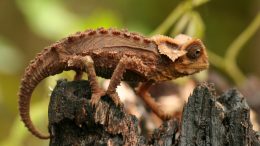
One of those species is the armored leaf chameleon. It’s a species from a drier area in Madagascar, the Tsingy de Bemaraha. It’s an endangered species, and it’s the largest species of the genus Brookesia, which are these miniaturized chameleons — you’ll often see pictures of them on a matchstick. But this is a species that has incredible ornamentation. They’re the only chameleon species that’s known to have osteoderms, these bones in the skin. They have these ornate projections off of their vertebral column that project out of their skins to create spines along their back. Overall coloration-wise, they’re just basically brown with a little bit of different hues of these drab colors, but they’re just incredibly intricate and interesting to me.
There’s a species in Tanzania, Trioceros laterispinis — one of its common names is the spiny-flanked chameleon. It looks kind of like those tree lichens that grow on branches. And it’s incredibly cryptic. You can just look at it and you can tell this is living in an environment that has a lot of those lichens and mosses. It’s beautifully evolved to live in that habitat.
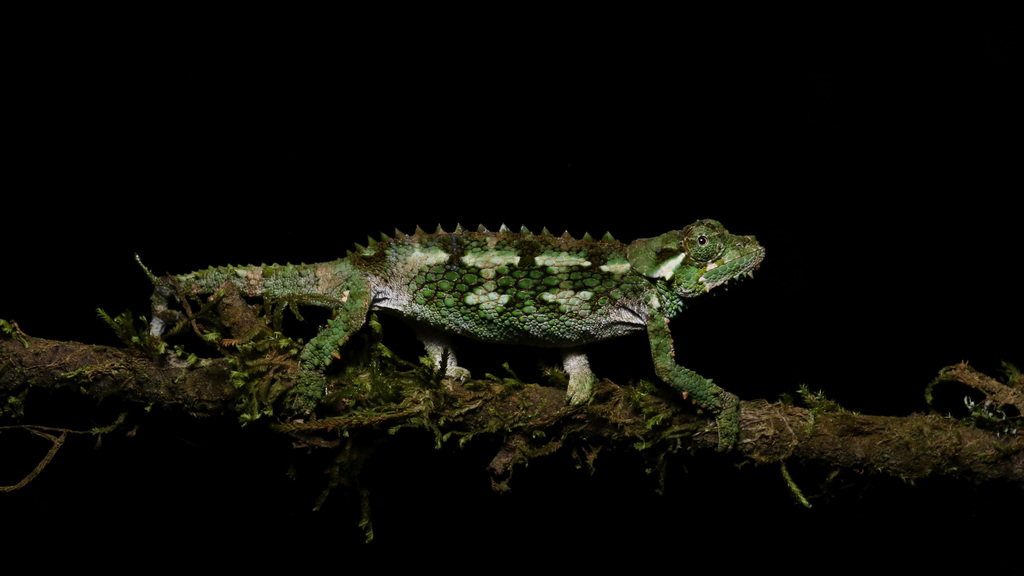
In both cases these aren’t species that are exhibiting bright pinks and blues and reds and greens or flashy colors, but there’s just something about them that I just find fascinating, because you could just see the way that they’re trying to conceal themselves and the way that they’re living in this environment and how they’re adapted to that place, that specific location. I just find that fascinating.
So what can we do to maintain the energy and interest of International Chameleon Day throughout the year?
Chameleons are exciting to the public. They’re interesting. People are intrigued by them. And I think that we really should try to harness that. I think, like you said, if we could see an increase in the coverage of chameleons — just generally, not only on International Chameleon Day, but across different times of the year — that that would go a long way to promoting our understanding and encouraging others to work with these animals in the future. Education about these animals and their local habitats doesn’t need to just be isolated to a single day. We can take advantage of opportunities as they come to educate local communities about the wildlife that they have around them and the value of some of these animals. That would be huge.
Trying to break down some of these longstanding prejudices toward these animals — that doesn’t happen overnight. It doesn’t happen if we’re just isolating that to one day a year. I think that International Chameleon Day is a huge benefit for trying to start those conversations and start those education programs and start those efforts.
But we really do need to continue those across the year at different times and try and promote those messages and get that information and that word out there more generally.

Previously in The Revelator:
This Month in Conservation Science: Trojan Seahorses and ‘Vampire’ Birds