
I’ve been a freshwater aquarium enthusiast for as long as I remember. Like many young kids, I started with guppies and quickly moved on to Amazonian fish, danios, angelfish, plecos, hatchetfish, and others. While I no longer keep fish, I’ve kept the interest.
And after all these years, certain fish species continue to attract my attention. Take, for example, the curious case of L046.
Every so often freshwater fish species show up in trade that haven’t been taxonomically described but are clearly recognized by those in the aquarium community, including traders, as something “new.” Because of their novelty value, these species can be traded at a premium, demanding higher prices. In some groups this is so common that a system has been devised “labelling” them, including ones maintained by the German aquarium magazine Die Aquarien- und Terrarienzeitschrift (DATZ).
L046 is one of those species.
Naming the Unnamed
The L stands for Loricariidae, the family of suckermouth armored catfish found in South America, including the Amazon. The 046 indicates that when they entered the trade, they were the 46th undescribed loricariid catfish recognized by DATZ.
I first came across L046 while working at the Zoological Museum in Amsterdam in the form of 8 and 10 alcohol-preserved specimens in two jars with the numbers ZMA120.655 and ZMA 120.457. My colleagues Isaac Isbrücker and Han Nijssen, two leading experts on Loricariidae, were sent no fewer than 224 specimens of this unnamed species by the time they taxonomically described the catfish in 1991:
“It was collected for commercial (aquarium) purposes by staff of Tropicarium Pará … The aim of this note is to provide this conspicuous species (referred to as “zebra pleco” in the aquarium trade…) with a scientific name … withdrawing it from its present nomenclatural anonymity.”
They were so different from other catfish that Isbrücker and Nijssen not only gave them their own species name (“zebra”) but even created a new genus for it — Hypancistrus. (Ancistrus is another genus of catfish, equally common in the aquarium trade, and hypo means less than, referring to the fact that Hypancistrus zebra had fewer teeth than Ancistrus and no filiform teeth.)
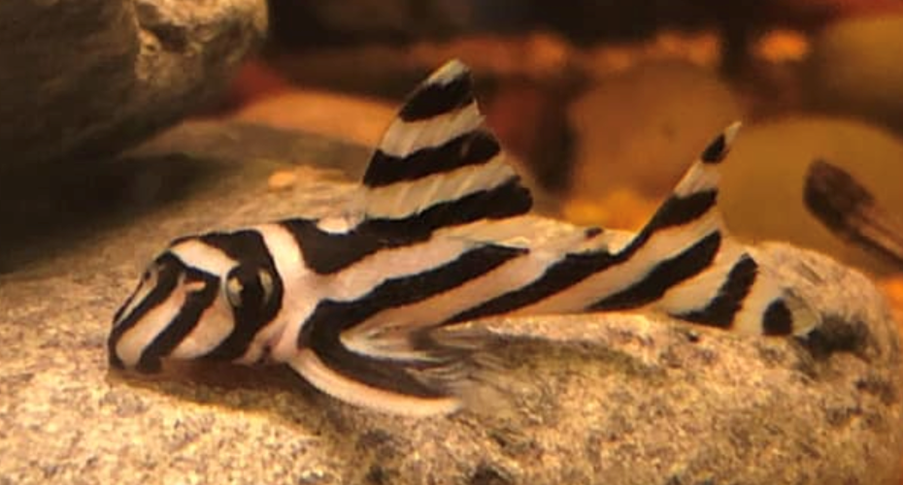
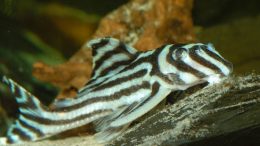
Hypancistrus zebra, the zebra pleco, still referred to as L046, is indeed conspicuous and quite stunning. These are rather small fish, white all over, with horizontal black lines on their bodies. It’s no wonder aquarium enthusiasts love them.
Protected But Still Traded
Endemic to the Xingu River in northern Brazil, this striking little fish first entered the international trade in 1988, three years before its scientific description. Brazilian authorities quickly recognized the need for regulation and banned export in 2004. That protected them in their native country.
View this post on Instagram
Extending that protection outside Brazil took a few extra steps. The international trade in wildlife is regulated through the Convention on International Trade in Endangered Species of Wild Fauna and Flora (CITES). In 2017 Brazil unilaterally added the zebra pleco to CITES appendix III, which regulates international trade and requires export permits or certificates of origin. In 2022 Brazil proposed to include the zebra pleco on CITES appendix I, which would have all but banned commercial trade of the species, but this was not accepted by the signatories to the treaty. A compromise was reached and the species was placed on appendix II, requiring all trade in it to carry export permits. Given its protected status in Brazil, no trade in wild-caught individuals is permitted.
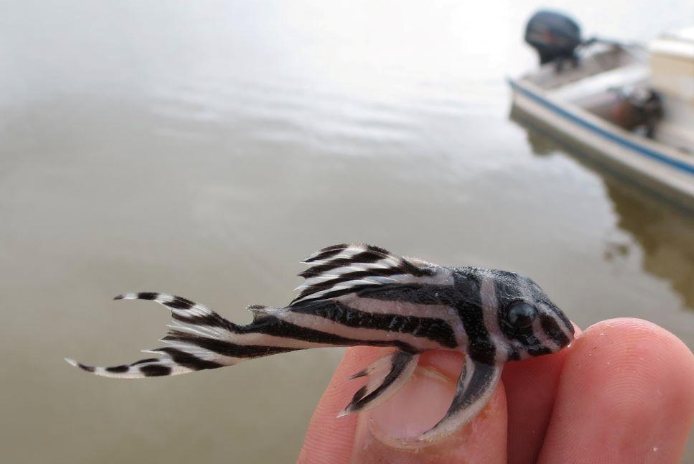
That hasn’t stopped trade, though — far from it. Zebra plecos are still sold by the tens of thousands every year.
Today the largest legal exporter of the zebra pleco is not Brazil but Indonesia, where they’re extensively bred. The founding stock for Indonesian exporters might have been individuals legally imported from Brazil prior to the 2004 export ban, but evidence suggests these were almost certainly augmented with wild zebra plecos obtained later.
Since 2017 Indonesia reported the export of almost 30,000 zebra plecos, all captive-bred. The most significant importers are the United States (about 22,000 individuals) and the European Union and United Kingdom (around 16,000 individuals).
But work done by Brazilian researchers show that this is far from a complete picture. Based on interviews with traders it they estimated that around 100,000 zebra plecos are still being taken out of Brazil every year. Mortality rates are high, and about half or more of the animals die during transport, but 70% of them are exported to China, often transited illegally through Colombia and Peru.
While it’s almost certain that a good proportion of the international trade in captive-bred zebra plecos is not reported, this suggests that the trade in wild-caught specimens is at least as large as legal trade in captive-bred ones.
Because of the attentiveness of, and protection given by, the Brazilian authorities, aquarium enthusiasts, and conservationists in Brazil — and because of the foresight of including the species on CITES appendix III (and later II) — we have good insight into the legal international trade in zebra plecos. Dedicated research into the illegal trade complements this picture. It also helps that the species was given a name only a few years after it entered the trade.
But many other species have not enjoyed those same benefits.
The Great Unknown
L046 was the 46th undescribed armored catfish in the DATZ. That was in 1988. We’re now at L600. This includes duplicates and species that have subsequently been given a scientific name. I estimate that there are some 380 armored catfish species that have yet to be named scientifically but are traded internationally. They have common names like Paru tiger pleco (L494), freckled tiger pleco (L493), Jatupu toad pleco (L431), and elegant zebra pleco (L399).
For some we know what genus they belong to, but for others we merely know this to the family level only (e.g., cotton spotted pleco, L068). Many of these undescribed but internationally traded catfish have very small geographic ranges. We have virtually no data on how sustainable this trade is, and all these species could benefit from better regulation of their international trade.
A Rose by Any Other Name…
We aquarium enthusiasts are strange people — we clearly love our fish, we take good care of them, we study them, we observe them, and we show them to our friends and families.
But for some species, we love them to death. I’ve often compared the exotic aquarium fish hobby with the market for cut flowers — roses, tulips and the like. When we buy our fish, like the cut flowers, they’re fresh and colorful, and we try to keep them that way. And we do — for a few months, a year, perhaps even a few years. But then they die, and we make another trip to the aquarium shop and buy new ones.
Agreed, some hobbyists do breed some of their fish, as I have on occasions. But in general community aquariums, where we keep various fish species at high densities, are not suitable for breeding. More fish die than are being born, and this keeps the aquarium trade alive and profitable.
Like tulips and roses, many of the freshwater fish people keep are bred commercially in very large quantities, often in countries outside the species’ natural range (like the zebra pleco in Indonesia). This part of the trade should have little negative impact on wild fish populations. But that’s not true for all species, and there’s an eager group of freshwater aquarium enthusiasts who do seek out wild-caught, novel, and newly or yet-to-be-described species that often have very small geographic distributions.
For the armored catfishes from South and Central America alone, this affects a few hundred species. But similar systems are in place for another group of armored catfish, such as the corys (Corydoras, C-numbers 1 to 158), dwarf cichlids (Apistogramma, A-numbers 1 to 243), and freshwater stingrays (Potamotrygron, P-numbers 1 to 62).
In yet other groups — including killifish, but also several groups of snakes and lizards — hobbyists and traders denote new forms by their collection locality rather than a numbered list (e.g., Biak, Aru, Kofiau, Sorong forms of green tree pythons Morelia viridis). If we take these other groups into account, we have thousands of species that are in trade but at the moment fly completely under the radar in terms of monitoring the impact of this trade.
Solving This Problem
How can we best regulate this trade in species that have not been given names?
While CITES mostly deals with regulating international trade in species that have a name (for example: tigers, Panthera tigris), there are also groups that are listed at higher taxonomic levels, such as genus (seahorses: Hippocampus spp.), family (hummingbirds: Trochilidae) or even order (Primates).
Should we do this with these unnamed aquarium fish and other traded species?
It is imperative that CITES as well as national level wildlife protection and legislation moves from passive compliance to proactive, data-driven management, with better levels of supply chain traceability.
From a precautionary perspective, international trade should not lead to the extinction of any species, even if it has yet to be given a name. So it would be prudent to consider listing some of these groups at this higher level, either in CITES appendix II, or, more easily, in appendix III.
For instance, L260 — traded under the name Queen Arabesque pleco since 1998 — has not been scientifically described, but it has been tentatively placed in the same genus as the zebra pleco (i.e., Hypancistrus). Like the zebra pleco, it is confined to a small river system in Brazil, the Rio Tapajós, and faces a similar set of threats (primarily overcollecting and limited protection of its habitat). Inclusion of all species of Hypancistrus on appendix II or III of CITES would allow for regulation of international trade. This would include the Queen Arabesque pleco even without it having been named scientifically.
Without this most basic level of protection, many of these species could disappear before science has even identified and named them.
L046 has avoided that fate — they’re too popular to disappear completely, although they remain critically endangered in the wild and face a precarious future in their native waters — but for many other unnamed species, continued existence is precarious at best.
References
de Sousa LM, Lucanus O, Arroyo-Mora JP, Kalacska M 2021. Conservation and trade of the endangered Hypancistrus zebra (Siluriformes, Loricariidae), one of the most trafficked Brazilian fish. Global Ecology and Conservation 27, 01570.
Isbrücker IJ, Nijssen H 1991. Hypancistrus zebra, a new genus and species of uniquely pigmented ancistrine loricariid fish. Ichthyological Exploration of Freshwaters 1(4), 345-350.
Phelps J, Webb EL, Bickford D, Nijman V, Sodhi NS 2010. Boosting CITES. Science 330(6012), 1752-1753.

Previously in The Revelator:
You Can’t Save a Species If It Doesn’t Have a Name