
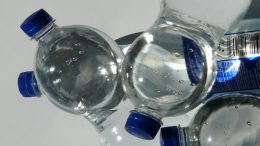
The global annual production of plastics rose to 400 million metric tons in 2022 and is projected to double by 2050. Many items produced are used once and then thrown away, including more than 30 billion plastic water bottles sold each year in the United States alone. Less than 10% of plastic waste is recycled.
Clearly the problem of plastic pollution in land and marine environments isn’t going away. This series looks at some approaches to dealing with it, including this examination of the increasing demand for water in disposable bottles.
A whopping 88% of Americans say they consume bottled water, according to an industry survey released in 2024. In fact that year we drank an estimated 16.4 billion gallons of it — 47.1 gallons and a shocking average of about 340 individual bottles per person. The retail cost of all those bottles reached $50.6 billion.
But there’s another cost to this practice: serious effects on our health.
Recent research from Concordia University in Canada shows that people who drink bottled water ingest up to 90,000 more microparticles of plastic a year than those who drink tap water. Microplastic particles range in size from 1 micron (a thousandth of a millimeter) to 5 millimeters. For perspective, a credit card is about 1 millimeter thick.
More concerning is another study that found higher amounts of nanoparticles in water bottles than previously reported. Nanoparticles are smaller than 1 micron.
An ever-growing body of research suggests that exposure to these particles, particularly the nano-sized ones, affects our immune systems, causes reproductive issues, impairs cognitive function, and increases cancer risk.
Why We Drink Bottled Water
Why do we drink so much water from plastic bottles in the first place?
In one survey reported by Statista, reasons given by consumers included convenience, better taste, mistrust of household water quality, unsuitability of tap water, preference for sparkling or flavored water, and the fact that some of the bottled stuff has more minerals.
Researchers at Canada’s University of Waterloo suggest that the choice also taps into something deeper: our fear of death. Their 2018 paper argued that this fear makes us want to avoid risks — and many people see bottled water as safer, purer, or more controlled.
The industry promotes those perceptions with marketing campaigns using celebrities and feel-good imaging. Some even directly play on fears about the safety of tap water and mistrust in government entities (think Flint, Michigan), according to Peter H. Gleick, president emeritus and chief scientist at the Pacific Institute for Studies in Development, Environment and Security and author of the 2010 book Bottled and Sold: The Story Behind Our Obsession With Bottled Water.
But is bottled water truly safer than tap?

Bottled Versus Tap
In the United States, tap water is significantly more regulated than the bottled stuff. The Environmental Protection Agency oversees municipal tap water systems, which must meet safety standards and are regularly inspected.
The water itself is treated to remove particles, chemicals, bacteria, and other contaminants and must be frequently tested. Water suppliers are required to provide testing results to customers every year in the form of Consumer Confidence Reports, also published online.
Not that there haven’t been problems with tap water systems. A 1986 EPA report, Reducing Lead in Drinking Water, showed that 36 million Americans were using tap water with high levels of lead. Much of that exposure came from lead pipes in homes. Congressional investigations and updates to the Safe Drinking Water Act followed and most of the problems were fixed, but not all (again, Flint).
More recently per- and polyfluoroalkyl substances (PFAS), known as “forever chemicals,” have been found in water sources around the world. These chemicals break down very slowly and have turned up in the blood of people and animals and at low levels in a variety of food products and soil. Studies have linked exposure to some PFAS to harmful health effects.
In 2024 the EPA adopted national standards for acceptable levels of PFAs in tap water, requiring water utilities to test for it until 2027. Testing results will be used to determine future regulations for regular PFAS sampling and reporting, and after 2029 utilities must use treatment processes to remove PFAS from drinking water. Researchers are studying the effectiveness of various removal technologies.
Contaminants or pathogens sometimes end up in municipal water supplies due to issues such as flooding or equipment malfunctions. Thankfully we know about these incidents because of the required testing. But hearing about them can sow doubt, causing people to switch to bottled water even if their water source is safe.
The Food and Drug Administration regulates bottled water, but only if it’s sold across state lines. Water that is both packaged and sold within the state of origin represents most of the bottled water market, according to Erik Olson, senior strategic director for health at the Natural Resources Defense Council. Individual states are responsible for these products, but 1 in 5 states have no regulations covering them, he adds.
And while the PFAS standards are supposed to apply to bottled water as well, Olson says: “As far as we know they haven’t been. Most bottled water probably doesn’t have PFAS, but how do we know?”
A study led by New York University researchers found that plastics — including but not limited to water bottles — are responsible for 93% of the exposure to PFOA, one of the most widely studied PFAS.
NRDC also found that about 22% of bottled water brands they tested contained chemicals at levels above state health limits or industry recommendations in at least one sample.
Ironically, an estimated 25 to 45% of bottled water is simply municipal tap water, repackaged and marked up in price, sometimes further treated, sometimes not. PepsiCo’s Aquafina and Coca-Cola’s Dasani, for example, are filtered tap water. Some brands, like Smartwater, promote that they use distillation to purify their water, but that process uses a lot of energy. Spring water typically requires minimal treatment but may come from stressed natural springs. The process of bottling water can be wasteful; for example, it takes 1.63 liters of water to make every liter of Dasani.
Olson points out that making and shipping plastic bottles uses a lot of fossil fuel, too. “It’s incredibly wasteful. Consuming tap water is more energy efficient and has a lower carbon footprint.”
Then there are those particles.
On April 2 the EPA announced plans to study microplastics and added microplastics as a priority contaminant group on a draft list under consideration for regulation in drinking water (along with pharmaceuticals as a group, 75 individual chemicals, and nine microbes). However, the agency has had significant layoffs and attrition under the second Trump administration. It is dispersing staff in its defunct Office of Research and Development to other programs and faces a proposed 52% cut to its budget. Food and Water Watch, a safe food, water, and climate advocate, warned that the announcement falls short of what we really need, which is a comprehensive nationwide monitoring program.
On top of that, the effort will address microplastics but not nanoplastics.
Sarah Sajedi, Ph.D., coauthor of the previously mentioned particle studies, has done experiments that found as many as 10 million nanoparticles in a liter water bottle. A major concern, she says, is that these particles accumulate in human tissues. Nanoparticles can enter the bloodstream and reach vital organs, causing chronic inflammation, oxidative stress on cells, hormonal disruption, impaired reproduction, neurological damage, and various kinds of cancer.
“We’ve only had technology in the past three to five years to detect the nanosized particles,” Sajedi says. “First you have to prove there is exposure, and now we have shown that it exists with bottled water.”
In another ironic twist, when companies started using thinner plastic in water bottles to help reduce plastic pollution, it made the particle problem worse.
Bottled water containers now typically use almost a third less PET plastic on average than other packaged beverages like soft drinks, which need thicker containers due to carbonation. But these thinner bottles shed more particles. Movement, such as from being carried around, and exposure to sunlight both increase release of particles.
“Shaking the bottle or UV exposure from leaving it in your car increases tenfold the shedding of the plastic,” says Sajedi.
Improving the quality of material used in bottles would reduce particle exposure but exacerbate the problem of plastic waste. Gleick’s book noted that people in the United States throw away 30 billion plastic water bottles each year. Only a small percent of those are recycled; many end up in the environment, often the ocean. The harms caused by this plastic pollution are well documented, with the Paris-based Organisation for Economic Co-operation and Development estimating its environmental damages at about $75 billion per year back in 2018 and a 2025 study blaming it for over $1.5 trillion in health-related economic losses per year.

So What’s a Thirsty Person to Do?
In general the safest thing to do is drink tap water — absent any specific problems in your area — and drink bottled water only on (rare) occasions.
“Say you’re at a baseball game and there’s no drinking fountains,” Olson says. “You’re not evil for consuming it once in a while. We just encourage people to think about it.”
If you’re concerned about your tap water, he suggests using a home filter system, which costs much less overall than bottles. One example shows that a family of four could save $2,878 a year using a pitcher-style filter system instead of bottled water.
“Another thing is, don’t be fooled by the names and pictures on the label that imply the water is from a mountain stream or pristine spring,” Olson says. “If the label says it is from a municipal source, it probably is just untreated tap water because that’s what rules require they say.”
When you need to buy bottled water, Sajedi suggests buying larger containers. “The quality of plastic is better with the jugs, which cuts down on your exposure to particles.”
Water is an essential human need. In places without reliable, safe water sources, many of these issues are moot, although experts argue the solution is to provide or improve infrastructure rather than relying on bottled water. But for the rest of us, it may be time to rethink our drinking habits.