
Recent studies give scientists a better understanding of animal migrations and their implications for conservation. This series focuses on what we’re learning about migrations and how that knowledge may help us protect certain species — in this case several ungulates in North America.
For decades wildlife scientists have been stumped by the burning question: Why did the ungulate cross the metaphorical road? It turns out the answer is simple: to find better food.
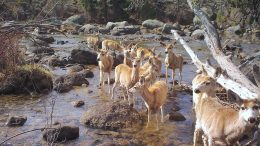
From 2014 to 2022, scientists used helicopters to net 254 adult female mule deer (Odocoileus hemionus) on their winter range in south-central Wyoming’s Red Desert. They weighed and measured each animal and fitted them with GPS collars programmed to transmit their locations every one to two hours. Over three autumn seasons, the team schlepped into the desert to locate collared deer and determine how many of their offspring survived. With remote sensing technology, they also matched the animals’ movements with the presence of forage.
The collar data showed that each summer some of these deer migrate around 200 miles, others about 70 miles, and some never leave the winter range. The researchers then used their other data to compare how these different strategies affected survival, reproduction, and population growth.
They found that migrants outperformed residents across the board, says Anna Ortega, who participated in the research as a Ph.D. student at the University of Wyoming. Migration provided superior foraging opportunities, which translated into higher fat, enabling females to carry more fawns to term, leading to population growth. While migration is widespread among ungulates, its benefits had not been well documented.
In contrast, the deer who stayed put, known as residents, survived at a lower rate, had fewer offspring, and showed declining numbers. The presence of the residents suggests that this tactic had been viable in the past, Ortega points out, but large-scale shifts such as increased human disturbance and changes in climate have made it less productive.
Bottom line, the research shows that the migrating mule deer are the engine for the whole population and helping maintain migrations is critical to preserving it.
But that presents unique challenges.
“This is a big swath of land and you’re dealing with things like different land ownerships, highway crossings, and fences that may be documented or may not,” says Ortega, now cofounder and lead researcher at Western Wildlife Research Collective, which provides data and tools for scientists and managers working to preserve wildlife in the American West.

Brandon Scurlock is wildlife management coordinator for the Wyoming Game and Fish Pinedale Region, which includes the Red Desert mule deer population. He stresses that management practices must both improve habitats and address barriers that prevent the animals from moving freely across landscapes.
One of those barriers is a bottleneck in the migration corridor between the town of Rock Springs and Fremont Lake.
“Twice a year, thousands of animals move through that narrow area. We partner with the U.S. Forest Service to temporarily close some of that land to human activity during certain months,” Scurlock says.
The state provides other protections within designated migration corridors, including reviewing proposals for development and trying to minimize their impact.
The Wider Problem
Mule deer are far from the only migrating animals facing challenges. The Convention on the Conservation of Migratory Species of Wild Animals, a legally binding international treaty under the United Nations working to ensure the long-term survival of migratory species and their habitats, reports that 49% of its listed species are decreasing and nearly 1 in 4 is threatened with extinction.
Common threats include habitat loss, habitat degradation and fragmentation, overexploitation, climate change, invasive species, and pollution.
The Convention’s species at risk include several dozen ungulates. These large, hoofed mammals affect ecosystem dynamics, moving nutrients and seeds between seasonal ranges and promoting plant diversity and growth of grasses and shrubs via their browsing habits. Trampling by their hooves aerates the soil, and their dung fertilizes it. Healthy populations support ecotourism and hunting.
Research shows that some 95 of 207 extant ungulate species are at least partially migratory and suggests that 7 of 10 recently extinct species were as well. The main threats to their migrations are human activities such as hunting, production of barriers such as fences and roads, and habitat degradation.
With technology like radio collars enabling more research on ungulate migrations, the Convention established a Global Initiative on Ungulate Migration, an international team of migration researchers headquartered at the University of Wyoming. The initiative is using research data to create a global atlas of detailed migration maps for 37 (so far) ungulate species. This atlas can inform conservation efforts, such as identifying where fences could be modified or removed and sites for road-crossing structures, as well as help target the most important areas to protect.
One of the mapped species helps illustrate what we’re learning — and why it’s important.
The Case of Caribou
Worldwide, migratory caribou (Rangifer tarandus) have declined by 65% over the past 20 to 30 years. The species was listed as vulnerable on the IUCN Red List of Threatened Species in 2015.
In North America roughly 2 million animals in some 12 major herds migrate, each to and from its own unique, specific calving ground. Caribou became extinct in the contiguous United States in 2019, and many populations in Canada are listed as Threatened or Endangered.
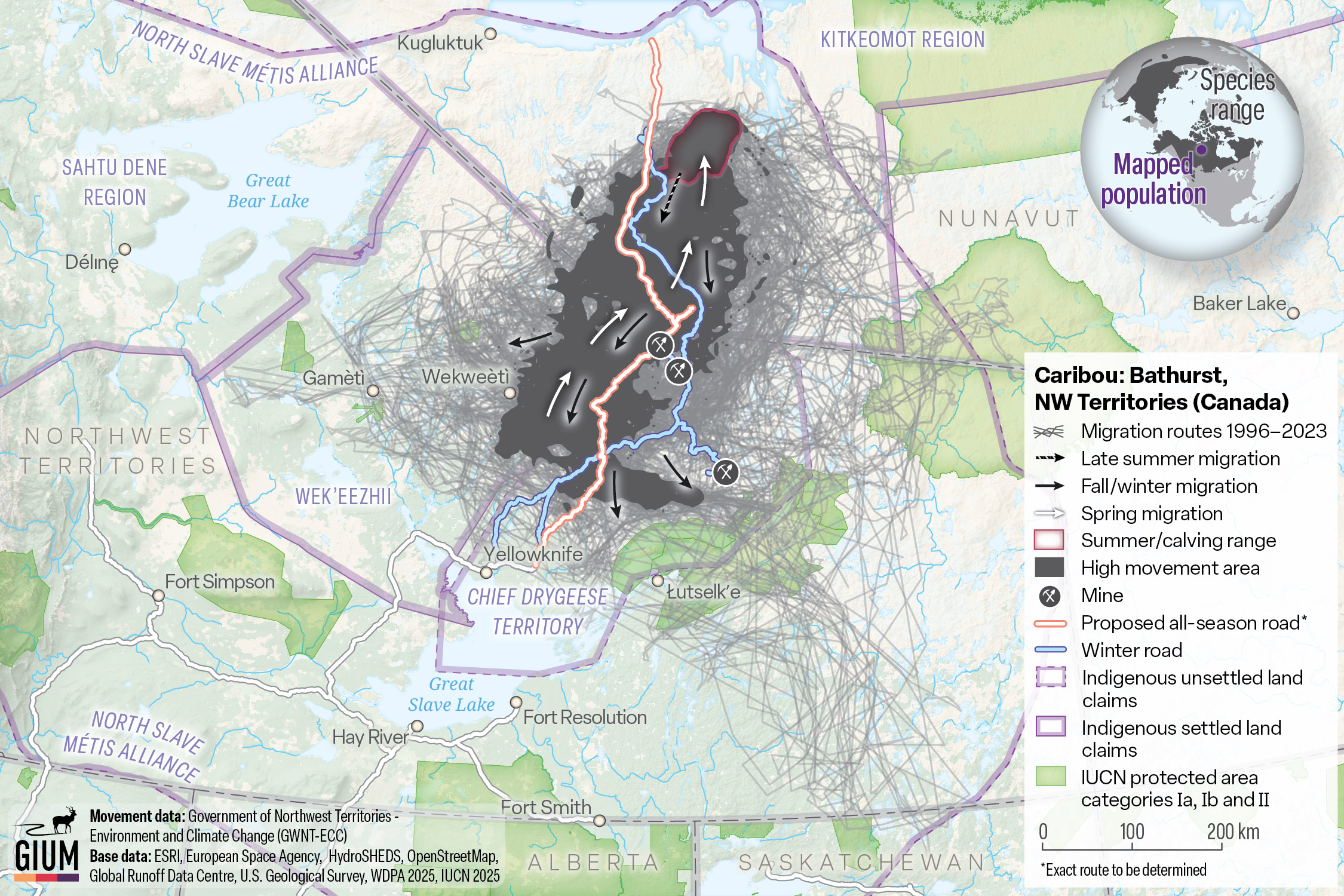
One of the maps in the GIUM atlas shows changes in the long-distance movements of the Bathurst caribou herd. Named for its historic calving grounds near Bathurst Inlet on the far northern coast of Canada, this herd of caribou once ranged from Nunavut to northern Saskatchewan, with yearly migrations covering 300 miles. The population has declined from 400,000 to fewer than 4,000 over the past 30 years, its range has shrunk 80% since 1997, and the migration now covers half its historic distance.
View this post on Instagram
The map also clearly shows a looming threat: a proposed all-season road, intended to connect mines and deep-water ports, cutting through the center of the herd’s range. The caribou are known to avoid existing mine operations and roads.
Another population, known as the southern mountain caribou, historically migrated vertically, up and down mountains, and horizontally, between mountainous areas and lowland forests. Tracking data from more than 800 animals across 27 subpopulations from 1987 to 2022 show that these migration areas have decreased significantly, with herds changing the duration, distance, or elevation of their movements. During their observation period, researchers also noted the near collapse of elevational migration for five subpopulations.
These changes apparently are due to increased human disturbance and the ongoing decline of the caribou population. In 2020 more than 30% of the migratory landscape of these caribou was disturbed by human behavior such as logging and oil and gas development.
“One way animals adapt to changing conditions is by moving,” says Clayton Lamb, a wildlife scientist at the University of British Columbia and lead author on the paper. “Keeping those paths intact in general is important to give them options to respond. As we chip away at that behavior, we’re chipping away at the ability to have large numbers of ungulates on the landscape.”
Research continues to show that migration is an essential practice for these and other ungulates. Loss of migrations and resulting population declines could have irreversible consequences for the fitness of the overall caribou population and ripple throughout the ecosystems they occupy. Migratory caribou make the landscapes that they trod more productive and provide prey for carnivores.
They also shape Indigenous communities that have hunted them for countless generations.
“The steep decline of the Bathurst herd is not just a biological concern; it represents a profound cultural and ecological loss,” Orna Phelan, wildlife biologist with the Indigenous North Slave Metís Alliance, said in a press release last year. “Conserving this herd means safeguarding our history, our identity and the health of the land we all share.”
“It is pretty remarkable to still have these migrations in 2026,” Scurlock says. “People can’t take it for granted and maybe need to give the animals a little bit of grace. We need a mindset to maintain these herds and their migrations, which keep them resilient and functional in the face of changes that are occurring.”