

The new year is kicking off with some fantastic reads. Here are some great new environmental books to while away the rest of winter — and set yourself up for spring.
We’ve adapted the books’ official descriptions below, and the link in each title goes to the publisher’s page. You can also find any of these titles through your local bookseller and library.
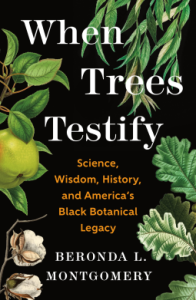
When Trees Testify: Science, Wisdom, History, and America’s Black Botanical Legacy
by Beronda L. Montgomery
This stunning cultural and personal reclamation of Black history and Black botanical mastery offers up lessons from the natural world shared through the stories of long-lived trees. Award-winning plant biologist Beronda L. Montgomery explores the ways trees are intertwined with Black history and culture. She reveals how knowledge surrounding these trees has shaped the United States since the very beginning and how trees are material witnesses to the lives of enslaved Africans and their descendants.
Discover how pecan trees were domesticated by an enslaved African named Antoine; sycamore trees were both havens and signposts for people trying to escape enslavement; poplar trees are historically associated with lynching; and willow bark has offered the gift of medicine. These trees, and others, testify not only to the complexity of the Black American narrative but also to a heritage of Black botanical expertise that, like Native American traditions, predates the United States entirely. Combining the wisdom of science and history with stories from her own path to botany, Montgomery talks to majestic trees, and in this unique and compelling narrative, they answer.
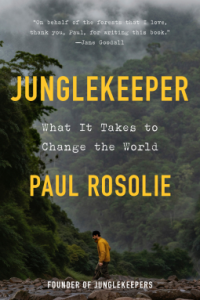
Junglekeeper: What It Takes to Change the World
by Paul Rosolie
Deep in the Peruvian jungle, there exists a corner of the world that remains untouched — one teeming with giant anacondas, where the haunting cries of howler monkeys send brightly colored macaws shooting across the canopy. It’s an ecosystem of stupendous biodiversity, uncontacted tribes, and adventures most people don’t even dare to dream of.
When he first set foot in the jungle, Rosolie was a dyslexic kid from Brooklyn who struggled to graduate from high school but had an undeniable calling to the outdoors. He was lucky enough to meet the Indigenous naturalist Juan Julio Durand, and together, over two decades, they have created Junglekeepers, an organization that has found a way to halt deforestation and protect more than 110,000 acres — inspiring millions along the way by documenting their progress online. But this work takes grit, and years in, Rosolie and Durand are past their “barefoot machete days,” grappling with chain saws, massive fires, illegal miners, and the worst of humanity. Here Rosolie brings us up close and personal with one of the wildest places on the planet and tells the incredible story of “first contact” with one of the most mysterious uncontacted tribes on Earth: the Mashco Piro.
This book is about the profound power of saying yes: to one’s calling, to sticking with your dream when it comes at a high cost, and to taking a stand to save what might otherwise be gone in a generation. It’s a story of calling, connectedness, and hope.
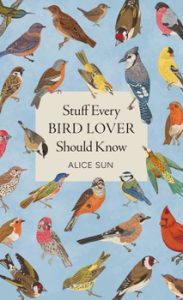
Stuff Every Bird Lover Should Know
by Alice Sun
Bird-brained: It’s not just an insult anymore. These tiny dinosaurs have captured the human imagination since the dawn of time, and this illustrated, accessible guide covers everything from bird anatomy and behavior to migration patterns and bird-watching tips.
This pocket-sized guide is the perfect gift for bird-watchers, bird owners, and anyone fascinated by our feathered friends. With handy diagrams, helpful tips, and fun trivia, it’s the perfect companion for anyone looking to get a bird’s-eye view on our avian allies, whether in the great outdoors or at their window feeder.
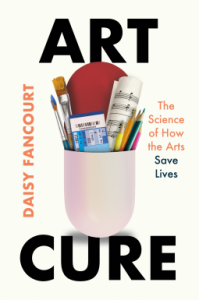
Art Cure: The Science of How the Arts Save Lives
by Daisy Fancourt
A groundbreaking book showing how the arts — alongside diet, sleep, exercise, and nature — are the forgotten fifth pillar of health.
This is pure science: the results of decades of studies gathering data from neuroimaging, molecular biomarkers, wearable sensors, cognitive assessments, and electronic health records. From professor Daisy Fancourt, an award-winning scientist and science communicator and director of the World Health Organization’s Collaborating Centre for Arts and Health, this book will fundamentally change the way you value and engage with the arts in your daily life and give you the tools to optimize how, when, and what arts you engage in to achieve your health goals. The arts are not a luxury in our lives. They are essential.
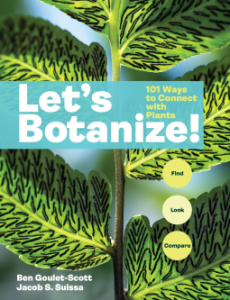
Let’s Botanize! 101 Ways to Connect with Plants
by Ben Goulet-Scott and Jacob S. Suissa
Botanizing is the new birding, and this fascinating book of 101 botany prompts is about the joy of getting to know plants in much the same way we get to know birds, through observation and attention.
Let’s Botanize! is a guide to learning about and understanding the world of plants, a hobby that can ease stress, bring joy, and deepen your connection with the incredible diversity of life all around you. With easy entry points and lush photography, the 101 prompts inspire readers to engage with plant life meaningfully each day by observing the parts, patterns, and processes that make plants so amazing.
A World Appears: A Journey Into Consciousness
by Michael Pollan
When neuroscientists began studying consciousness in the early 1990s, they sought to explain how and why three pounds of spongy gray matter could generate a subjective point of view — assuming that the brain is the source of our perceived reality. Pollan takes us to the cutting edge of the field, where scientists are entertaining more radical (and less materialist) theories of consciousness. He introduces us to “plant neurobiologists” searching for the first flicker of consciousness in plants, scientists striving to engineer feelings into AI, and psychologists and novelists seeking to capture the felt experience of our slippery stream of consciousness.
In Pollan’s dazzling exploration of consciousness, he discovers a world far deeper and stranger than our everyday reality. Eye-opening and mind-expanding, A World Appears takes us into the laboratories of our minds, ultimately showing us how we might make better use of the gift of awareness to more meaningfully connect with the world and our deepest selves.
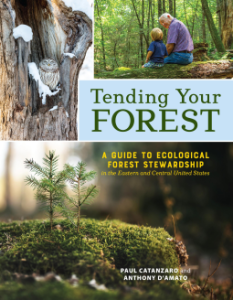
by Paul Catanzaro and Anthony D’Amato
How do you care for the health of your forest? This comprehensive guide empowers landowners with the knowledge of how to manage a family forest to capture more carbon, encourage wildlife and biodiversity, and build a more resilient future.
Tending Your Forest brings a fresh, ecological perspective to forest management, providing landowners with the information they need to understand their forests and their options for stewarding them in the face of new challenges, such as climate change and invasive species. With the help of key professionals, landowners from Maine to Maryland and Missouri to Minnesota can practice ecological forestry to achieve goals such as restoring old-growth characteristics, protecting wildlife and biodiversity, sequestering and storing carbon to mitigate climate change, preserving tree species at risk of extinction, and sustainably harvesting trees for local wood products. Finally, landowners will learn how to ensure their legacy by passing land on to their heirs and making use of conservation easements and other tools for protecting the land long into the future.
Great Reads for Our Young Folks:
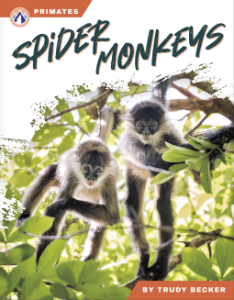
by Trudy Becker
This book explores the physical features and behaviors of spider monkeys. It also covers the primates’ diet, habitat, and life cycle. Short paragraphs of easy-to-read text are paired with colorful images to make reading engaging and accessible. The book also includes a table of contents, fun facts, sidebars, comprehension questions, a glossary, an index, and a list of resources for further reading. Part of the Primate Series from Apex Books. Apex books have low reading levels (grades 2–3) but are designed for older students, with interest levels of grades 3–7.

Zombie Spiders and Asteroid Blasters: 16 Incredible Ways That Scientists Are Changing the World
by Maynard Okereke
Have you ever heard of a spider being turned into a useful robot? Or a real-life planetary defense team protecting the Earth from asteroids? It sounds like science fiction — but it’s not. Take a wild ride with Maynard Okereke, the Hip Hop MD, into some of the most fascinating and strange corners of scientific research, from physics and engineering to ecology and neuroscience. These wacky wonders of nature and technology will wow all readers and inspire budding scientists to look at the world with fresh curiosity and consider how science can be used to help people, help nature, or enhance our understanding about the world. Interviews with real scientists highlight representation for diverse children and how scientists from a wide range of backgrounds are working to build a better future for our planet.
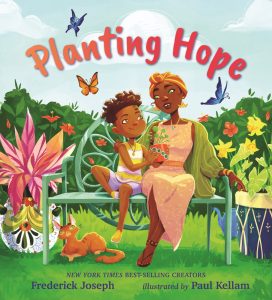
by Frederick Joseph, Illustrated by Paul Kellam
Everyone in Henry’s family loves plants and gardening. So why can he never get his little plant to grow, no matter how hard he tries? His mom has been able to grow anything since she was young and even cultivated a whole orchard to help feed people who were hungry. Henry imagines his mother as a great tree, with branches wrapping around the whole community. “People and seeds have a lot in common,” his mom likes to say. “If you want them to grow strong, nourishment and sunlight aren’t enough — they also need hope.” When Henry’s mom becomes sick and it looks like she may not recover, this belief that she’s sown in her son becomes key to what happens next. Frederick Joseph, award-winning author of The Black Friend, offers a bighearted story about keeping hope alive in the face of grief — and a gentle allegory with an upbeat message about healing a fragile planet.
***
Make the first part of 2026 an inspiring time through these informative reads. You can find hundreds of additional environmental book recommendations in the “Revelator Reads” archives.
And let us know what you’re reading: Drop us a line at [email protected].

Previously in The Revelator:
Wild Reads: 10 New Books that Celebrate Wildlife and Their Environments