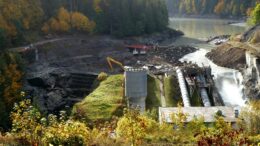
For centuries the Elwha River on Washington’s Olympic Peninsula supported some of the West Coast’s most impressive salmon runs. The river’s cold waters, fed by alpine glaciers on the surrounding mountains, flowed 45 miles from the heart of what is now Olympic National Park to the Salish Sea.
Ten distinct runs of salmon and oceangoing trout, including all five North American Pacific salmon species, spawned in the Elwha watershed — until a pair of dams built in the early twentieth century blocked salmon from 90% of the river.
More than a century later, advocacy by the Lower Elwha Klallam Tribe and conservation groups led to the dams’ removal. With the Elwha flowing free again and other habitat restoration in progress, the Olympic Peninsula is regaining its status as a salmon hotspot. Olympic National Park lies at the center.
“Olympic is probably the greatest salmon sanctuary in the national park system outside of Alaska,” says Colin Deverell, acting Northwest regional director for the National Parks Conservation Association. “We’re talking over 3,000 miles of rivers and streams in an area bigger than Rhode Island — most of it wilderness.”
View this post on Instagram
The future of salmon in this vast region is far from assured, however. In fact staff and funding cuts at the National Park Service have jeopardized habitat restoration work in the Elwha and other park watersheds at a crucial time. Olympic Park’s fisheries team has dropped from five staff at the beginning of the second Trump administration to one intern by the start of this year.
“There’s no way one person could possibly fulfill all the responsibilities the national park has toward its fish and communities who rely on healthy fisheries,” says Deverell.
This hollowing out of staff has meant salmon returning to the Elwha go uncounted, hindering work to establish sustainable fisheries. Efforts to end illegal fishing in the Quillayute River are languishing, while a restoration project on the park’s Ozette Lake is in danger of being put on hold. Tribal nations and nonprofits who partner with the Park Service are struggling to fill the gaps.
“The near obliteration of Olympic Park’s fisheries program means it’s all but impossible to do the science that supports restoration work,” Deverell says. “It makes managing fish for people and communities that much harder.”
Staffing Exodus
When Congress passed the Elwha River Ecosystem and Fisheries Restoration Act in 1992, it set in motion a long process meant to restore Elwha salmon to something like their former glory. The law authorized the Department of the Interior to acquire and decommission the river’s Elwha and Glines Canyon dams, a project completed in 2014. This was only the beginning for salmon recovery, however.
View this post on Instagram
The newly freed Elwha transported sediment that had been trapped behind the dams for a century downstream, where it replenished the river delta. Restored river and estuary habitat supported not just returning salmon, but other species from Dungeness crabs to lampreys.
In 2023, for the first time since the dams came down, the Lower Elwha Klallam Tribe held a ceremonial and subsistence fishery for coho salmon on the Elwha. Supporting treaty-protected Tribal fishing rights is a major objective for salmon recovery. However, setting science-based parameters for fishing requires reliable data about salmon numbers — data the Park Service is best equipped to provide.
“There are now almost no fisheries staff left to do this work,” Deverell says.
The federal hiring freeze of 2025 put seasonal additions to Olympic Park’s fisheries staff on hold. Though the freeze expired in fall, uncertainty over possible future hiring directives from the administration continues to pose challenges. Budget cuts compound the problem.
“The freeze may be technically over, but there’s still very little hiring going on,” Deverell says. “Writ large, the reason comes down to budget issues and personnel directives from the Trump administration.”
Last year Trump’s “Big, Beautiful Bill” cancelled $267 million in funding for staff at the already chronically underfunded Park Service. The departure of all Olympic National Park’s permanent fisheries biologists follows a larger pattern of staff exoduses caused by lack of funding and untenable conditions.
“These are experienced biologists we’re losing,” says Tim McNulty, a board member of Olympic Park Advocates, one of the organizations that pushed for removal of the Elwha dams. “They’re people who have spent years working with the park’s many important salmon streams.”
The void left behind may not be visible to most visitors, but it puts Tribal nations and others who collaborate with the Park Service on fisheries in a difficult situation.
“It’s a predicament, because we share the load of conducting certain salmon and steelhead surveys with the Park Service and Washington State Department of Fish and Wildlife,” says Frank Geyer, natural resources director for the Quileute Tribe.
For centuries the Quileute have fished in the Olympic Peninsula’s Quillayute watershed, which includes the Sol Duc, Calawah, and Bogachiel Rivers. The watershed is one of the few places that supports year-round salmon and steelhead fishing, thanks to the Tribe’s sustainable stewardship.
“Going into last fall, we were trying to figure out how to cover work the park would normally do,” Geyer says. “Soon we’ll be starting winter steelhead surveys. If the park doesn’t have staff to help, it’ll be up to the comanagers — Quileute Tribe and WDFW — to cover the gap.”
With basic monitoring of salmon runs barely getting done, many habitat restoration efforts have fallen by the wayside. Most of these projects are far less visible than removal of the Elwha River dams. However, they are part of the same legacy of restoration — one that’s now in danger of faltering.
Struggling Restoration
For the past few summers, Liz Allyn has worked to restore the edges of Olympic National Park’s Ozette Lake, home to a population of Endangered Species Act-listed, genetically distinct sockeye salmon.
Logging near the lake in the 20th century caused erosion that led to sediment building up in the shallows, burying gravel beds where sockeye once made their spawning nests, called redds. Plants took root, further changing the environment in ways that made life harder for salmon.
“Huge areas that used be spawning sites are now covered in native vegetation,” Allyn says. “It’s not an invasive species situation, but it’s a human-caused impact that negatively affects salmon.”
View this post on Instagram
Removing the vegetation would allow sediment to wash away, restoring spawning opportunities. It’s a relatively simple project with big payoffs that is currently being spearheaded by the Makah Tribe with support from the Coast Salmon Partnership, where Allyn works. However, with almost no park resources going toward it, the effort is in danger of collapsing.
“The park has been underfunded for a long time, so their engagement was always limited,” Allyn says. “But in the past, park staff were there to handle permits and certain logistics. Last summer we didn’t even have that.”
Throughout the park similar examples of restoration falling through the cracks amid short staffing abound. In a tributary of the Quinault River, efforts to remove a pile of rubble from a dilapidated bridge that impedes salmon swimming upstream have been delayed. Along the Sol Duc River, Tribal elders can’t access traditional fishing grounds because of a washed-out road.
Even more worrying, there’s often no one on hand when a crisis hits.
Disaster Response
On July 18 a petroleum tanker truck ran off U.S. Highway 101 on the northern Olympic Peninsula, overturning and spilling 3,000 gallons of diesel into a tributary of the Elwha. While the Lower Elwha Klallam Tribe and Washington’s Department of Ecology rushed to respond, the ability of the Park Service to assist was hamstrung by lack of staff.
Thousands of salmon fingerlings died in the disaster. A more robust initial Park Service response wouldn’t have prevented this, but it could have helped provide vital information as multiple agencies struggled to assess the damage and calculate penalties for the company involved. It’s yet another example of how Trump administration cuts are impeding continued salmon recovery in a dynamic landscape.
At more than 922,600 acres, Olympic National Park is a big place. Ninety-five percent is Congressionally designated wilderness, much of it consisting of steep mountains and valleys. Keeping tabs on salmon throughout such a vast area, let alone outside the park boundaries, is an enormous undertaking that requires deep understanding of the watersheds involved.
When long-time fisheries staff depart, they take years of valuable experience and institutional knowledge with them. This means any new hires will have a lot of catching up to do before they can fill the same roles.
“The decisions we’re making today are built on decades of science that’s given us a picture of how salmon populations are succeeding or failing over time,” Deverell says. “All of that is informed by data from the park. But now we’re at a point where the Park Service can no longer fill that function.”

Previously in The Revelator:
The Monumental Effort to Replant the Klamath River Dam Reservoirs