
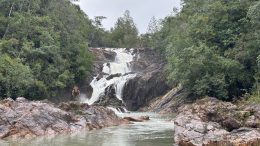
The Place:
We’re in Noj Kaax Meen Elijio Panti National Park, a protected area situated in the heart of the Maya Mountains in western Belize, near the border with Guatemala. Bounded by the Mountain Pine Ridge Forest Reserve and the Macal River, it’s an extremely biodiverse, tropical rainforest with some remaining intact areas of primary broadleaf forest.
Why It Matters:
Named after the world-renowned traditional Mayan healer Don Elijio Panti, Noj Kaax Meen (which means “canopied rainforest of healers”) Elijio Panti National Park is home to some of the most emblematic and endangered wildlife of the Neotropics, including jaguars, spider monkeys, tapirs, and scarlet macaws. It also conceals several large, intricate caves full of artifacts and relics where the ancient Mayas conducted rituals and ceremonies. Some of these caves remain unexplored.

The Mayas’ descendants still live here. They consider the land, rivers, trees, herbs, birds, jaguars, and other wildlife to be their heritage, which they are honored to take care of. They’re dedicated to preserving the delicate balance between the territory and the people. The legacy that Don Elijio Panti, a spiritual leader as well as a healer, left within the national park is also paramount for this community, as he offered ceremonies of gratitude to the spirits and the land, meditated, and gathered sacred herbs to serve his people.
The park is full of economically important trees, such as mahogany, nargusta, rosewood, sapodilla and ceiba, which supply food for many insects, birds, and mammals. They’re also important habitat: In their massive crowns and branches, you can find nests of top predators such as the stunning ornate hawk-eagle or the black-and-white owl.
At the same time, as if these trees represent a duality of blessing and curse, they attract national and international logging companies, eager to cut them down and extract their precious timber at any cost.
The Threat:
Last July the government granted a logging license to Belize Woodmark Designs Ltd., allowing the furniture company to harvest wood in approximately 11,500 acres of the area known as the Western Hardwoods. The area is situated within the Mountain Pine Ridge Forest Reserve and directly borders Elijio Panti National Park to the south. According to park head ranger Rigoberto Saqui, this logging concession will severely harm ecological connectivity and populations of mammals with large home ranges like jaguars and tapirs.
“It’s a ripple effect that happens when a logging concession begins in an area,” he says. “When new roads are opened, it makes it easier and accessible for other loggers, looters, or poachers to do illegal activities within the park.”

He also mentions a consequence that would reach areas even beyond the park.
“The Western Hardwoods are very sensitive when it comes to its ecological functioning: It has a lot of headwaters that flow into the major tributaries of Belize.” This means the effects of the operation would stretch into areas and communities far away from the park through damage done by logging to water quality.
The license was granted for 30 years, with the option to be extended for an additional 30, and was granted despite the opposition of the chief of the Forest Office Department.
My Place in This Place:
I visited Elijio Panti National Park for the first time last summer, leading a group of college students in environmental sciences from the United States. As an ecologist and passionate naturalist, I immediately connected with the exuberant jungle and spent the days walking trails up and down, checking jaguar and tapir tracks, birdwatching, swimming in the beautiful waterfalls, exploring deep caves, and learning nonstop from the park rangers who accompanied us.
I felt privileged to witness such a vibrant landscape, and I also observed my students’ constant enthusiasm in discovering the rainforest for the first time, opening their eyes to a new world full of unique species, sounds, and scents.
When the rangers told me about the ongoing situation with the logging concession, I felt powerless in the face of corporate interests that care nothing about the needs of nature and the people, so I decided to do my part and share the voice of the park and its community. I will continue to bring my students to Elijio Panti every year, so they can learn about rainforest ecology, its brimming wildlife, and the endless challenges human greed poses to the common good.
Who’s Protecting It Now:
The Itzamna Society has co-managed the park with the state since 2001. A team of four brave rangers patrols about 16,000 acres (roughly 9,000 football fields) of hilly terrain. They have been navigating the dense rainforest and working to control groups of illegal poachers, loggers, and looters with the help of two motorbikes, machetes for opening small trails, their strong legs, and determined hearts.
What This Place Needs:
In the words of the head ranger Rigoberto Saqui, “The number of rangers that we have — it’s not enough, and we have seen the consequences of our limited capacity to safeguard the park.”
The park requires more personnel to initiate proper long-term research and be more efficient in patrolling and protecting the area. It’s crucial to initiate research to identify key sites within the park that may contain hidden Maya caves before looters arrive. There’s also a significant chance that the park holds new-to-science species of insects, plants, and other groups, which means that the community and rangers need equipment and training to start monitoring and collecting data.
The rangers also need to acquire fire-extinguishing equipment, since the dry season is about to start and they have had difficult experiences in the past trying to fight wildfires with minimal tools. The government does not have either the initiative or the capacity to provide help in these situations.
The Itzamna Society is trying to secure a large grant that will allow it to implement several processes to better address the park’s needs, but the team is struggling to write the proposal due to a lack of grant-writing expertise. If anyone reading this article has experience with grant-writing for conservation or environmental causes and is willing to help, please contact me so I can connect you with the team.
Lessons From the Fight:
The oppression carried out by companies and corporations to destroy the last wild places on this planet for mere profit and personal convenience can’t be allowed anymore. It’s clear that we can’t trust governments to take care of mountains, rivers, and forests, so what are our options as citizens?
Elijio Panti National Park and the Itzamna Society are a clear example of the power of communities in protecting nature. This Mayan community will defend their place with their lives as long as they exist, because it’s part of their identity and legacy.
Similarly, rebuilding our relationship with nature is a duty we have as humans, so we’re intrinsically motivated and ready to do whatever’s necessary to safeguard the sources of food, clean water, and clean air for ourselves and the rest of the fellow creatures with whom we share the world. Most of Western society has lost our connection to our territories, allowing private interests to extract the land’s wealth without resistance.
Lastly, one of our greatest powers as citizens comes from our ability to make informed choices as consumers. What would happen if no one bought any furniture from the company that received the logging concession that now threatens Elijio Panti National Park — or other exploitative companies?
Follow the Fight:
Follow the Itzamna Society, the local community and co-managers of Elijio Panti National Park, on Facebook.
And visit the park’s own website, where you can find detailed information on this unique protected area.
Share your stories:
Do you live in or near a threatened habitat or community, or have you worked to study or protect endangered wildlife? You’re invited to share your stories in our ongoing features, Protect This Place and Save This Species.

Previously in The Revelator:
Antidote for Despair in the Shawnee National Forest